Reverse mortgage title problems can stop a loan as surely as a low appraisal. Before a HECM can close, everyone on the deed has to be accounted for and every old lien released on record. In this Nassau County case, an adult child on the deed and an unreleased HELOC nearly derailed an otherwise strong application.
Key takeaways
- A DIY quitclaim deed from 2018 had made the couple’s 43-year-old son a legal co-owner of the house.
- A HELOC paid to zero years earlier was still open on county records, because the bank never recorded a release.
- An adult child on the deed is not an automatic denial under HUD rules, but it adds signatures, conditions and risk to the loan.
- Both problems were caught before the application was submitted, fixed with an attorney and the title company, and the loan closed.
- Checking your own deed and old liens first is the cheapest step in the whole process.
Who were the homeowners, and what did they need?
A retired couple in Nassau County who wanted to stop making a mortgage payment. I’ll call them Arthur and Eleanor Vance, ages 74 and 71. Their names and some details are changed to protect their privacy.
They owned a classic colonial appraised at $620,000. Like a lot of Long Island homeowners on a fixed income, they were squeezed from three directions:
- A fixed Social Security income
- Property taxes that go up nearly every year
- A $45,000 balance on their old mortgage, with a monthly payment that took a real bite out of the budget
They wanted a Home Equity Conversion Mortgage, or HECM, the FHA-insured reverse mortgage most Long Island homeowners use. Their goals were simple. Pay off the old mortgage so they would have no required monthly principal and interest payment, and set aside a line of credit for the years ahead.
One thing a HECM does not change: property taxes, homeowners insurance and upkeep stay your responsibility for as long as you have the loan, and falling behind on them can make the loan due and payable. Arthur and Eleanor understood that from the start. They also keep the title to their home, exactly as with any other mortgage.
On paper they looked like a textbook approval. Then we pulled the title report.
What did the title report turn up?
A gap between who lived in the house, who owned it on paper, and what the county still thought was owed. I see this across Long Island and the five boroughs more often than families expect.
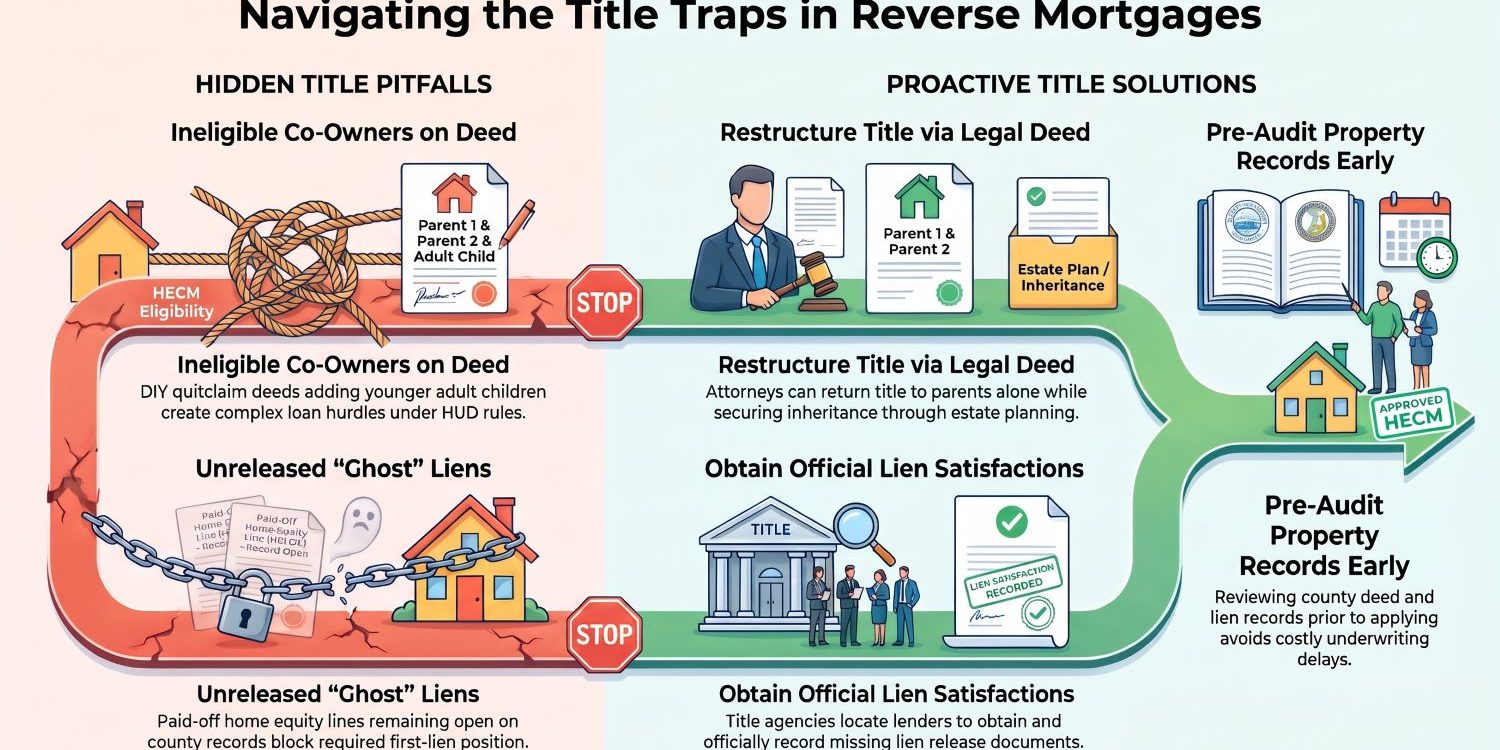
1. A DIY quitclaim deed
In 2018, Arthur and Eleanor signed a quitclaim deed adding their adult son to the title “so it would be easier for him to inherit.” No attorney was involved. With one signature, their son, now 43, became a legal co-owner of the house.
2. A co-owner too young to borrow
A HECM borrower must be at least 62, and every borrower must be on the title. A 43-year-old can’t be a borrower. That turned a simple two-person loan into a three-owner file.
3. A “ghost lien”
A home equity line of credit opened in 2010 still showed as an open lien at the county clerk. Arthur had paid it down to zero years ago, but the bank never recorded a satisfaction of mortgage, the document that releases a lien from the public record.
Had we sent the file to underwriting without catching these issues, the lender’s underwriter and the title insurer would have stopped it, likely weeks into the process, with the clock running on the appraisal and the counseling certificate.
Can a reverse mortgage close with an adult child on the deed?
Sometimes, yes. Federal rules (24 CFR 206.35) allow an owner who is not a borrower to stay on title, as long as that owner signs the mortgage and a certification consenting to the loan. So the son on the deed was not an automatic denial.
It was still a real complication. HUD’s separate protections for a non-borrowing spouse do not extend to children, and a younger co-owner brings his own life into the loan file. Families in this position generally choose between two paths.
| Child stays on title as a non-borrowing owner | Deed returns to the parents’ names | |
|---|---|---|
| Who signs the loan | Parents as borrowers. The child signs the mortgage and a consent certification | Parents only |
| Counseling | Borrowers must be counseled. Lenders may require the child to participate as well | Borrowers only |
| Risk to the title | A judgment, lien, bankruptcy or divorce involving the child can attach to the child’s share | The child’s finances no longer touch the house |
| Lender rules | HUD allows it, but some lenders and investors add stricter conditions | Standard file |
| Estate plan | The child already holds an ownership interest | Inheritance is handled in a will, trust or other estate document |
| Who decides | The family, with a New York real estate or elder law attorney. Changing a deed can affect taxes, inheritance and Medicaid planning, so this is not a loan officer’s call. | |
💡 On a phone? Swipe the table left and right to see every column.
Why does a paid-off HELOC still matter?
Because a HECM has to be the first lien on the house, and the public record said another lender was still ahead of it. A title insurer won’t insure a reverse mortgage with an open lien sitting on record, even one with a zero balance.
New York law is on the homeowner’s side here. A lender must present a satisfaction of mortgage for recording within 30 days of payoff, and owes the borrower $500, $1,000 or $1,500 when it is 30, 60 or 90 days late (RPAPL §1921 and RPL §275). Even so, old releases slip through the cracks, especially when the original bank has merged, closed or sold its loans.
That last part is what makes a ghost lien slow to fix. Someone has to work out which institution owns that old loan today before anyone can sign the release.
How did we get this loan to closing?
By fixing the title before the file went to underwriting, with each problem handled by the right professional. As licensed mortgage professionals in New York, we do not practice law, draft deeds or give estate planning advice. New York’s Judiciary Law reserves that work for attorneys. Our job is to spot title problems early and make sure they are fixed properly.
- We sent the family to an attorney. We flagged the deed on day one and recommended that Arthur and Eleanor speak with a New York real estate or estate planning attorney. After reviewing the options, the family and their attorney chose to return the house to Arthur and Eleanor’s names alone with a corrective deed, signed by their son. Their wishes for the house now live in their estate plan, outside the loan.
- We cleared the ghost lien. Our title agency traced the 2010 HELOC to the institution that now held it, obtained a satisfaction of mortgage, and recorded it with the Nassau County Clerk. That put the HECM in first-lien position.
- The couple completed HUD counseling. Like every HECM borrower, Arthur and Eleanor met with a HUD-approved counselor before the application went in. The session covers the costs, the obligations and the alternatives to a reverse mortgage.
- Underwriting ran the Financial Assessment. HUD requires the lender to review credit history and whether the household can keep paying property taxes and insurance. With Long Island tax bills, this step carries real weight. When the review raises concerns, the lender can require a Life Expectancy Set-Aside, or LESA, which holds back part of the loan to pay those bills directly. Some homeowners ask for one on purpose.
- The loan closed. With clean title and both borrowers verified at 74 and 71, the HECM paid off the $45,000 mortgage at closing. The remaining available funds went into a line of credit Arthur and Eleanor can draw on when they need it.
Today the Vances have no required monthly principal and interest payment. They still pay their taxes, insurance and upkeep, and the deed is back in their names alone.
Not sure what’s on your deed? Send us a copy of your deed and tell us about any old mortgages or home equity lines. We’ll tell you what we see and what would need attention before you apply. Ask for a pre-application review →
What does a HECM cost on a $620,000 home?
The main costs are FHA mortgage insurance, an origination fee and standard closing costs, and most of them are set by HUD formulas. The table below shows how each one works on a home like the Vances’, so you can see where the money goes.
| Item | How it is set | On a $620,000 home |
|---|---|---|
| Maximum claim amount | The lesser of the appraised value or the 2026 FHA limit of $1,249,125 | $620,000 |
| Upfront mortgage insurance (MIP) | 2% of the maximum claim amount, usually financed into the loan | $12,400 |
| Ongoing mortgage insurance | 0.5% a year of the loan balance, added to the balance | Grows with the balance |
| Origination fee cap | HUD caps it at 2% of the first $200,000 plus 1% of the rest, never more than $6,000 | Up to $6,000 |
| Other closing costs | Third-party fees such as the appraisal, title insurance and recording | Varies by property |
| Principal limit | The amount you can borrow. HUD sets it from the youngest borrower’s age and the expected interest rate on the day the loan is priced | Changes with age and rates |
| First-year draw limit | The greater of 60% of the principal limit, or required payoffs and costs plus 10% of the principal limit | Paying off a mortgage counts as a required payoff |
💡 On a phone? Swipe the table left and right to see every column.
Illustrative example only, October 2026, based on a $620,000 appraised value, a youngest borrower aged 71 and the 2026 FHA HECM limit. The principal limit and available line of credit depend on current interest rates and are not shown. Your figures will differ. This is not an offer or a commitment to lend.
The 2026 maximum claim amount of $1,249,125 applies to FHA case numbers assigned from January 1 through December 31, 2026 (HUD). The Vances’ home sat well under it, so its full appraised value counted.
One feature matters for a couple like this. The unused part of a HECM line of credit grows over time, at the same rate the loan balance accrues: the loan’s interest rate plus the 0.5% mortgage insurance rate. A line opened in your early 70s and left mostly untouched is larger ten years later. For a rough number on your own home, try our reverse mortgage calculator.
How can you check your own title before you apply?
Pull a copy of your deed and the recorded documents on your property from your county clerk’s office, then go through these six questions. Most of the problems in this case would have shown up here.
- Whose names are on the deed? Anyone besides you and your spouse needs a plan before you apply.
- Did you ever sign a quitclaim, add a child, or move the house into a trust? Trusts can work, but the lender has to review the trust documents.
- Is every old mortgage and HELOC marked satisfied? A loan paid down to zero is not released until a satisfaction is recorded.
- Has a spouse or co-owner passed away? You may need a death certificate or estate paperwork recorded to update the title.
- Are there judgments, tax liens or unpaid water bills? These have to be paid or cleared at closing.
- Is the house held in a life estate? A HECM can still work, but the people who inherit the remainder generally must sign and be counseled.
If an old lien shows up, contact the lender that was paid off and ask for a recorded satisfaction. Doing it now, before you apply, keeps it off the critical path of your loan.
When do you need an attorney instead of a lender?
Any time the fix involves changing who owns the house or how it passes to your family. A loan officer can tell you what the lender needs. Only an attorney can tell you what’s right for your family.
- Adding or removing anyone from a deed. It can change capital gains treatment for your heirs, gift tax reporting and who controls the house.
- Medicaid planning. Transfers of a home are reviewed under look-back rules, and a mistake can be costly. Talk to an elder law attorney before you change anything.
- Trusts and life estates. Whether yours works for a HECM depends on its exact terms.
- A deceased co-owner or an open estate. Title may need to pass through probate or be updated before a lender can proceed.
- Divorce. An ex-spouse still on the deed needs to be addressed in the settlement or with a new deed.
If you aren’t sure which bucket you’re in, it’s fine to call us first. We’ll tell you plainly when a question needs an attorney.
Want someone to look at your title before you apply?
Send us a copy of your deed and tell us about any old mortgages or home equity lines. We’ll point out anything that could slow a reverse mortgage down, and tell you plainly when it’s a job for an attorney. No application and no obligation.
Ask for a pre-application review →
Or call Perry at 631-574-1306
Reverse mortgage title questions
Can my adult child be on the deed if I get a reverse mortgage?
Sometimes. HUD rules allow an owner who is not a borrower to stay on title, as long as that owner signs the mortgage and a certification consenting to the loan. Only owners 62 or older can be borrowers, and some lenders set stricter rules. Many families decide to return the home to the parents' names instead, with an attorney's help.
Do I have to take my son or daughter off the deed?
Not always. The answer depends on the lender's requirements, your child's own finances and your estate plan. Removing a child from a deed can also change taxes, inheritance and Medicaid planning. That decision belongs with a New York real estate or elder law attorney, not with your loan officer.
Can my children still inherit the house?
Yes. When the last borrower leaves the home, your heirs can keep it by paying off the loan, sell it and keep whatever equity remains, or let the lender sell it. A HECM is non-recourse, so they never owe more than the home is worth. To keep the house, they pay the lesser of the loan balance or 95% of the appraised value.
What if an old mortgage or HELOC was paid off but never released?
The title company can usually get a satisfaction of mortgage from the original lender or whoever bought its loans, and record it with the county clerk. New York law requires lenders to present a satisfaction for recording within 30 days of payoff. Start early, because tracking down a merged or closed bank can take weeks.
Does a reverse mortgage mean I have no housing payments at all?
No. A HECM can remove your required monthly principal and interest payment, but you still pay property taxes, homeowners insurance, any HOA or common charges, and upkeep on the home. Falling behind on any of those can make the loan due and payable, so budget for them before you apply.
Is reverse mortgage money taxable?
Loan proceeds are generally not treated as income, because they are borrowed money rather than earnings. How a draw affects your own return, deductions or means-tested benefits such as Medicaid is a question for a tax advisor or elder law attorney. Ask one before you rely on any general statement.
Is counseling required before a reverse mortgage?
Yes. Every HECM borrower, and any non-borrowing spouse, must complete a session with a HUD-approved counselor before the application goes in. Other owners on the deed may need counseling too. The session covers costs, obligations and alternatives, and you receive a certificate the lender needs to proceed.
Perry Pappas, NMLS #3771. Jet Direct Funding Corp. DBA Jet Direct Mortgage and Senior Reverse Network, NMLS #3542, Licensed Mortgage Banker, NYS Department of Financial Services. This case study is for educational purposes only and is not legal, tax or financial advice. Names and identifying details have been changed, and figures are illustrative. Borrowers must be at least 62, occupy the home as their primary residence, complete HUD-approved counseling, and continue to pay property taxes, homeowners insurance and maintenance. Failure to meet the loan terms can result in the loan becoming due and payable. Equal Housing Opportunity.
This material is not from HUD or FHA and has not been approved by HUD or any government agency.
Sources
- 24 CFR 206.35, Title of property which is security for HECM, covering the rules for non-borrowing owners on title.
- U.S. Department of Housing and Urban Development, FHA lender resources, the source for the 2026 HECM maximum claim amount of $1,249,125 (Mortgagee Letter 2025-22).
- New York Real Property Actions and Proceedings Law, §1921, Discharge of mortgage.
- Cullen and Dykman, New cases shed light on the requirement of lenders to record mortgage satisfactions, summarizing the 30-day rule and penalties.
- New York Codes, Rules and Regulations, 3 NYCRR Part 79, Reverse Mortgage Loans.

Perry Pappas is a Senior Vice President of Reverse Mortgage Sales at Jet Direct Mortgage with over 26 years of mortgage industry experience. He specializes in retirement housing strategy, senior liquidity planning, and helping older homeowners evaluate how home equity may fit into long-term financial stability. Perry is known for simplifying complex retirement financing concepts and providing straightforward education around modern reverse mortgage strategies.
Call/Text: 516-851-0696
Jet Direct Mortgage | 4875 Sunrise Hwy, Bohemia, NY 11716
Perry Pappas NMLS #3771 | Jet Direct Mortgage NMLS #3542 | Equal Housing Lender