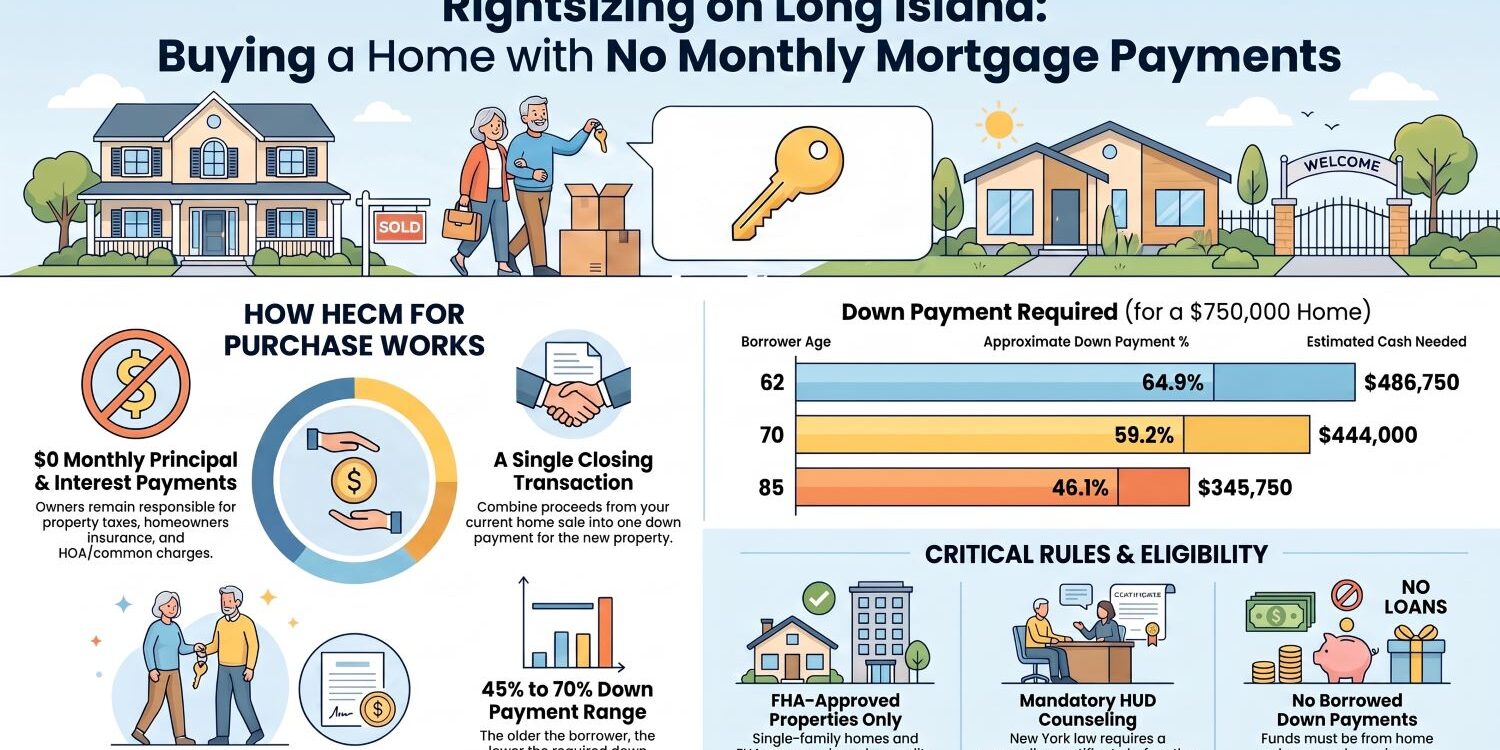
HECM for Purchase lets a Long Island buyer aged 62 or older combine one down payment — roughly 45% to 70% of the price, depending on age and rates — with an FHA-insured reverse mortgage to buy a new home in a single transaction, with no required monthly principal and interest payment. Property taxes, insurance, HOA dues and upkeep remain the buyer's responsibility.
Key takeaways
- One transaction, not two — you sell, you buy, and you take title on closing day with no required monthly mortgage payment.
- You bring a down payment of roughly 46% to 65% of the purchase price; the older you are, the less you bring.
- Down payment funds must be your own or a documented gift — borrowed money of any kind is not allowed.
- The condo must be FHA-approved. This is the number one reason Long Island H4P purchases fall apart, and it is checkable before you make an offer.
- Co-ops are not eligible, and every borrower must be at least 62 — even in a 55+ community.
Most people on Long Island first hear about this the same way. They have lived in the same Levittown, Hicksville or Massapequa house for thirty years. The kids are gone, the stairs are getting old, and the house is worth far more than they paid. They want a newer, smaller place in one of the 55+ communities in Plainview or Melville — and then they price one, see $1.1 million, look at their $850,000 of equity, and decide they cannot afford to move.
Often they can. They are just doing the math with the wrong loan.
How does HECM for Purchase actually work?
It is one transaction, not two. You bring a large down payment to the closing table, an FHA-insured Home Equity Conversion Mortgage covers the rest of the purchase price, and you take title to the home the day it closes. From that point there is no required monthly principal and interest payment. The loan balance grows over time instead of shrinking, and it becomes due when the last borrower sells, moves out permanently, or passes away.
You own the home. Your name is on the deed, exactly as it would be with any other mortgage. That surprises people, because the myth that the bank owns the house is the most persistent piece of misinformation about this product.
Two transactions become one. Without H4P, most downsizers either pay all cash — which drains the retirement savings they will need for the next thirty years — or take a conventional mortgage and commit to a monthly payment on a fixed income. HECM for Purchase sits between those two, and the trade-off is honest: you keep more cash, and you build no equity through payments.
Where does the down payment come from?
This is where files go wrong, so it is worth being exact. FHA cares not just about the amount but about where the money came from.
| ✅ Allowed | 🚫 Not allowed |
|---|---|
| Proceeds from selling your current home | Personal loans of any kind |
| Verified savings and investment accounts | Credit card advances |
| Documented gifts from family | Bridge loans |
| Employer relocation assistance | An unsecured line of credit from a relative |
| Certain disaster-relief grants | Any borrowed money dressed up as a gift |
💡 On a phone? Swipe the table left and right to see every column.
Funds have to be yours and documented. The seller, the builder or the agent may contribute up to 6% of the sales price or appraised value, whichever is lower, toward closing costs — origination and lender fees, appraisal, title, prepaid taxes and insurance, discount points, and the initial FHA mortgage insurance premium. Real estate commissions and home warranties sit outside that 6% cap. What no one may do is contribute toward the required down payment itself. That money comes from you.
Most buyers here are selling one house to buy another, and the proceeds are the down payment. That means the sale and the purchase need to be coordinated, and your attorney should know from the start that the purchase is an FHA-insured reverse mortgage, not a conventional loan.
How much will I need to put down at my age?
More than a conventional loan, and less than all cash. The percentage is set by your age — the older you are, the more the loan will advance and the less you bring — along with the expected interest rate at the time you lock and the FHA lending limit.
The table below assumes a $750,000 purchase, a single borrower, and an expected rate environment as of September 1, 2026. These figures are illustrative only. Your actual number will differ, and the percentages move whenever rates move.
| Your age | Approximate down payment | On a $750,000 home |
|---|---|---|
| 62 | 64.9% | $486,750 |
| 65 | 62.8% | $471,000 |
| 70 | 59.2% | $444,000 |
| 75 | 56.4% | $423,000 |
| 80 | 52.1% | $390,750 |
| 85 | 46.1% | $345,750 |
💡 On a phone? Swipe the table left and right to see every column.
Illustrative example only. Assumes a 5.75% note rate and a 5.5% expected rate as of 09/01/2026, a single borrower, and a property within the FHA lending limit. Percentages include closing costs and the initial FHA mortgage insurance premium.
Two details behind that table. If there are two borrowers, the calculation uses the age of the younger one. And the 2026 FHA HECM lending limit is $1,249,125 — that is the most home value an FHA-insured reverse mortgage can count. Above that number you are looking at a proprietary jumbo product instead, which is common in places like Sands Point, Old Westbury and the East End.
Get your H4P down payment number. Tell us the community you are looking at and your age, and we will give you the real figure for that specific purchase — not a range. There is no application and no credit pull to get it. Ask for your number →
Can I use this to buy in a Long Island 55+ community?
Yes, and it is the most common use of H4P here. Nassau and Suffolk have a deep supply of age-restricted and active adult communities — Country Pointe Plainview, Encore Luxury Living in Jericho, Meadowbrook Pointe in Westbury, The Greens at Half Hollow in Melville, the Leisure communities out in Ridge, and dozens more. The buyer profile that H4P was designed for is exactly the buyer these communities are built for.
Three things to know before you write an offer.
1. The age restriction and the HECM age requirement are two different rules
A community's deed rider may say 55+, and HECM requires every borrower to be at least 62. Being eligible to live there does not make you eligible for the loan. If you are 58 and your spouse is 63, you have a specific situation to plan around, not an automatic no — see the FAQ below.
2. Common charges are underwritten as part of your obligation
Long Island community fees frequently run several hundred dollars a month and cover landscaping, snow removal, amenities and sometimes exterior maintenance. FHA counts them when assessing whether you can sustain the home. A high monthly charge does not disqualify you, but it does shape the picture.
3. The HOA's finances get reviewed too, not just yours
For any condominium form of ownership, FHA looks at the association's reserves, its delinquency rate and its planned special assessments. A community with a large assessment coming next fiscal year can complicate an otherwise clean file.
What is the condo approval problem, and how do I check before I fall in love with a unit?
This is the single most common reason a Long Island H4P purchase falls apart, and almost nobody hears about it until they are already in contract.
A HECM on a condominium requires the condo to be FHA-eligible — either through full project approval, where the whole development is HUD-approved, or through Single-Unit Approval, where FHA approves the individual unit for that one transaction. Many Long Island condo and townhome communities have never sought FHA approval at all, because their sales have historically been cash or conventional.
The criteria a project has to satisfy include reserves funded at a meaningful level in the budget, owner-occupancy above half the units, delinquent HOA dues under a set threshold, no single entity owning too large a share of the units, adequate fidelity bonding, and no special assessment planned in the near term.
Here is the practical order of operations, and it costs you nothing:
- Get the exact legal project name and address from the listing agent.
- Have us check it against HUD's condominium approval list before you make an offer.
- If it is not approved, ask whether Single-Unit Approval is realistic — that depends on the association's numbers, and the association will need to provide documents.
- If neither path works, you now know to look at a different community, weeks before your deposit is at risk instead of after.
Send us the address. We will tell you within a day whether the project is approvable, and we will tell you if it is not. Check a community →
What Long Island properties will HECM for Purchase not finance?
Cooperatives are not eligible
Congress authorized HECMs on co-ops in 2008, but HUD has never implemented that authority, so co-op units remain outside the program. On Long Island this matters mainly at the western end and for buyers considering Queens or Brooklyn; if the building is a co-op, this loan is not available for it, and no lender can work around that.
New construction needs a certificate of occupancy
Several Long Island 55+ communities are still building. A HECM cannot close on a home that is not finished — the CO has to be issued before the loan can fund. If you are buying from a builder, that timing belongs in the contract.
The home must be your primary residence
This is not a loan for a second home in Montauk or a rental in Florida. You have to occupy the property, and you certify your occupancy annually.
Eligible property types include single-family homes, FHA-approved condominiums, townhouses, and two- to four-unit properties where you occupy one unit — a combination that fits a lot of Long Island housing stock.
What does this look like in real numbers?
An illustration. Assume a married couple, both 70, who own a Levittown ranch free and clear and are moving to a condo in a Plainview 55+ community.
| Step | Amount |
|---|---|
| Sale price of the Levittown home | $900,000 |
| Less commissions, NYS transfer tax and attorney fees (est. 6.5%) | −$58,500 |
| Net proceeds | $841,500 |
| Purchase price of the Plainview condo | $650,000 |
| Required down payment at age 70 (59.2%, includes closing costs and initial MIP) | −$384,800 |
| Cash remaining after the move | ≈ $456,700 |
💡 On a phone? Swipe the table left and right to see every column.
Illustrative example only, September 2026. Assumes both borrowers age 70, no mortgage on the departing home, an FHA-approved condominium project, and the rate assumptions stated above. Your figures will differ.
They now own a newer home with no stairs, no required monthly mortgage payment, and roughly $456,000 in liquid savings they did not have before. What they still owe every month: Nassau County property taxes, homeowners insurance, and the community's common charges. What they gave up: the equity that would have accrued had they paid down a conventional loan, and a smaller inheritance for their children unless the home appreciates faster than the balance grows. That is the honest ledger. Some families look at it and move ahead; some look at it and decide to pay cash instead. Both are reasonable.
If you are on the other side of this — selling the family home rather than buying — our guide to reverse mortgage options for Levittown homeowners covers what that side of the transaction looks like.
How long does it take, and where does counseling fit?
Plan on 45 to 60 days from contract to closing, which is comparable to a conventional purchase and sometimes faster than an FHA forward loan.
The sequence:
- Counseling first. Every HECM borrower in New York must complete counseling with a HUD-approved counselor, and for a HECM it cannot be waived. Do it early — the certificate is required before the file can proceed, and scheduling is the most common source of delay.
- Application and disclosures, including the DFS-approved list of housing counselors your lender is required to give you.
- FHA appraisal, ordered through an approved appraiser. If the appraiser flags required repairs, they generally have to be completed before closing, and on a purchase that is the seller's negotiation, not yours.
- Condo approval check, running in parallel — earlier if possible.
- Underwriting, which includes a financial assessment of your credit history and your ability to keep up with taxes, insurance and charges. If that assessment raises concerns, FHA may require a Life Expectancy Set-Aside, where part of the loan is reserved to pay taxes and insurance directly.
- Closing, at which you take title.
Closing costs include the origination fee, the initial FHA mortgage insurance premium, third-party fees, and New York's mortgage recording tax. Most of these are financed into the loan rather than paid out of pocket, which is why the down payment percentages in the table above already account for them.
Ready to find out what you would actually need?
Send us the community you are considering and your age. We will give you the real down payment figure for that purchase, check the project's FHA status, and tell you plainly if this is not the right tool for your situation. No application, no credit pull, no obligation.
Get your H4P down payment number →Or call 866.203.1231
HECM for Purchase Long Island FAQs
Can I use HECM for Purchase to buy a home in another state?
Yes. The loan is federal, so you can sell a Long Island home and buy in Florida, the Carolinas or anywhere else, as long as the new home becomes your primary residence and the lender is licensed in that state. We are licensed in New York; for an out-of-state purchase we can point you to a lender who is licensed where you are buying.
What happens if I die shortly after buying the home?
Your heirs inherit the home and the loan balance, which at that point would be close to the original loan amount. They can sell the home and keep whatever is left after the loan is repaid, refinance it into their own mortgage and keep it, or hand it back. Because the loan is non-recourse, they never owe more than the home is worth at that time.
Can I be forced to leave the home?
Not as long as you meet the loan's conditions: live there as your primary residence, keep the property taxes and homeowners insurance current, pay your HOA or common charges, and maintain the home in reasonable condition. The loan does not have a maturity date that forces you out at a certain age. It becomes due when the last borrower permanently leaves the home.
Can I sell the house later if I change my mind?
Yes, at any time and without a prepayment penalty. You sell, the loan balance is repaid from the proceeds, and anything remaining is yours. This is worth saying plainly because a lot of people assume they are locked in. You are not.
What happens to the equity in the home?
The balance grows as interest and mortgage insurance accrue, so your equity generally shrinks over time unless the home appreciates faster than the balance climbs. Whatever equity remains at the end belongs to you or your heirs. If the balance ever exceeds the home's value, FHA insurance covers the shortfall and neither you nor your heirs owe the difference.
My spouse is under 62. Can we still do this?
Not as a borrower. Every HECM borrower must be 62 or older. A younger spouse can be listed as an eligible non-borrowing spouse, which lets them stay in the home if the borrowing spouse dies first — but the loan amount is calculated using the younger spouse's age, which means a substantially larger down payment. If one of you is close to 62, waiting can meaningfully change the numbers. This is a conversation to have before you write an offer.
Do I need good credit and income to qualify?
There is no minimum credit score, but there is a financial assessment. FHA reviews your credit history and residual income to judge whether you can sustain the property taxes, insurance and charges. Past credit problems do not automatically disqualify you; they may result in a Life Expectancy Set-Aside, where a portion of the loan is reserved to pay those bills for you.
Can my children give me the money for the down payment?
Yes, if it is a documented gift rather than a loan. Gift funds are an acceptable source, and the donor signs a letter confirming no repayment is expected. What is not acceptable is borrowed money dressed up as a gift — if there is an expectation of repayment, it does not qualify.
Perry Pappas is a Senior Vice President of Reverse Mortgage Sales at Jet Direct Mortgage with over 26 years of mortgage industry experience. He specializes in retirement housing strategy, senior liquidity planning, and helping older homeowners evaluate how home equity may fit into long-term financial stability. Perry is known for simplifying complex retirement financing concepts and providing straightforward education around modern reverse mortgage strategies.
Call/Text: 516-851-0696
Jet Direct Mortgage | 4875 Sunrise Hwy, Bohemia, NY 11716
Perry Pappas NMLS #3771 | Jet Direct Mortgage NMLS #3542 | Equal Housing Lender