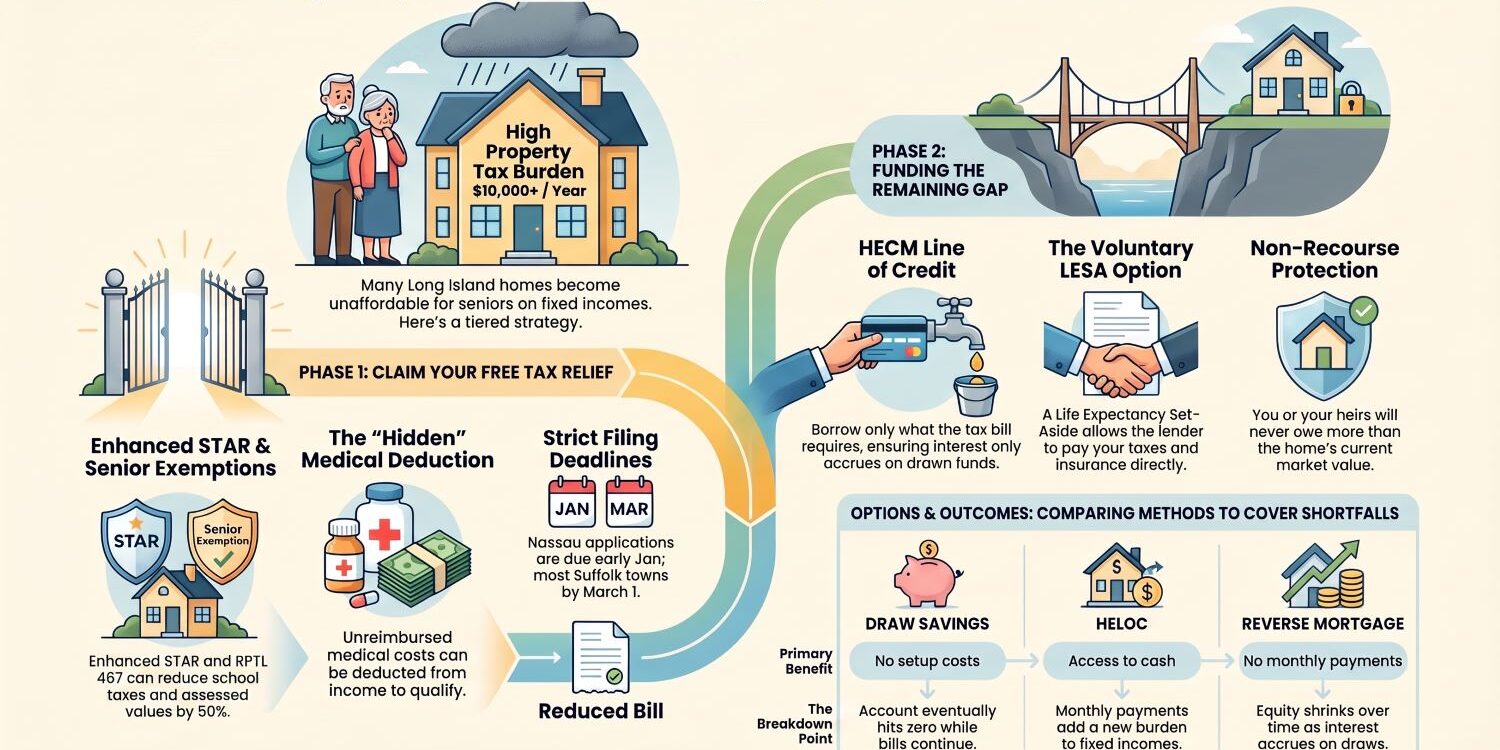
Claim every exemption you qualify for first, because Enhanced STAR and the senior citizens exemption cost nothing and can cut a Nassau or Suffolk tax bill by thousands a year. If the bill is still unaffordable after that, a reverse mortgage line of credit can fund it from your equity. Taxes, insurance and upkeep stay your obligation.
Key takeaways
- Do the free things first. Enhanced STAR and the senior citizens exemption are worth more to most households than any loan, and they cost nothing to claim.
- Nassau and Suffolk both sit above the ceiling the U.S. Census reports for median real estate taxes, which is $10,000 or more per year.
- A reverse mortgage line of credit lets you draw only what the tax bill requires, when it is due, rather than borrowing a lump sum.
- You can ask for a Life Expectancy Set-Aside on purpose, so the servicer pays your taxes and insurance directly and the bill stops being your job.
- Missing the filing deadline costs you a full year. Nassau's falls in early January; most of Suffolk's is March 1.
Why does a paid-off Long Island house still feel unaffordable?
Because the mortgage was never the biggest bill. On Long Island the school tax is, and it does not retire when you do.
The U.S. Census stops reporting a precise median once a county passes $10,000 in annual real estate taxes. Nassau and Suffolk are both above that ceiling, which is why the published figure for each county reads "$10,000+" rather than a number. Against a median home value of roughly $633,800 in Nassau and $490,800 in Suffolk, that is a large share of a fixed income going out the door every year, for a house that is already paid for.
The pattern we see most often looks like this. The mortgage was retired around 2015, and Social Security and a modest pension cover groceries, utilities and the car. Then the school tax bill arrives, the household drains savings to cover it, and the same thing happens the following year, slightly worse.
Nothing has gone wrong here. The bill has simply outgrown the income.
What should I claim before I borrow a dollar?
Every exemption you are entitled to. This is not a courtesy paragraph before the sales pitch. For a household under the income limits, these exemptions are worth more than most loans, they cost nothing, and no one at this company earns anything when you claim them.
| Program | Who qualifies | What it does |
|---|---|---|
| Enhanced STAR | Age 65 or older, primary residence, combined income of $110,750 or less for the 2026–2027 school year | A larger school tax reduction than Basic STAR, delivered either as a credit check or as an exemption on the bill |
| Basic STAR | Primary residence, income up to $500,000 for the credit or $250,000 for the exemption. No age requirement | The standard school tax reduction. You move up to Enhanced at 65 if you meet the income test |
| Senior citizens exemption (RPTL 467) | All owners age 65 or older, 12 months of ownership, income under the limit your town or district adopted. Nassau's ceiling is $58,399 | Reduces the taxable assessed value by up to 50%, on a sliding scale as income rises |
| Veterans exemptions | Wartime, combat and disabled veterans, and some surviving spouses. Alternative, Cold War and Eligible Funds versions exist | Reduces assessed value on the county, town and, where adopted, school portion of the bill |
| Limited income and disabilities | Documented disability plus income under the local ceiling. Nassau's is $58,399 | Works like the senior exemption for homeowners who are not yet 65 |
💡 On a phone? Swipe the table left and right to see every column.
Income limits and sliding-scale brackets are set annually and vary by town, village and school district. Confirm your figures with your assessor before relying on them.
Three things people get wrong about these.
Enhanced STAR and the senior exemption are separate, and you can hold both
They are different programs with different income definitions. Enhanced STAR reduces the school portion of the bill. The senior citizens exemption reduces the taxable assessed value used across the bill, where the county, town or district has adopted it. Qualifying for one does not enroll you in the other, and plenty of households on Long Island are collecting one while sitting eligible for the other.
The income test is not simply your tax return
For the senior citizens exemption, New York starts from federal adjusted gross income and then modifies it. Social Security benefits that were not in your AGI are generally added back, unless your locality opted out. Unreimbursed medical and prescription costs may be deducted, which pulls some households under the ceiling who assumed they were over it. If your medical spending is significant, run the calculation rather than eyeballing it.
Enhanced STAR is now largely automatic, but only if you are already enrolled
Beginning in 2026, New York upgrades exemption recipients from Basic to Enhanced STAR automatically at 65 and notifies the assessor, so you no longer file with your local assessor for that step. That helps the people already in the system. If you never registered for STAR at all, nothing happens automatically, and that is the household most likely to be leaving money on the table.
Pull last year's tax bill and look for the STAR line and any senior or veterans line. If either is missing, contact your assessor. In Nassau that is the Department of Assessment; in Suffolk it is your town assessor. If the exemptions alone solve the problem, you do not need a loan, and we would rather you know that now than after a closing.
The exemptions are in place and I am still short. Now what?
Then you are choosing between four real options, and it is worth seeing them side by side before anyone talks to you about a loan.
| Option | What it costs you | Where it breaks down |
|---|---|---|
| Draw down savings | Nothing to arrange. You spend money you already have | Finite. Works until the account is empty, then the same bill arrives again |
| Sell and move | Transaction costs and leaving the house and the neighborhood | Often the right answer. Rarely the answer people want, and rents on Long Island are not cheap either |
| HELOC or home equity loan | A required monthly payment, plus qualifying on income and credit | The monthly payment is the problem you were trying to solve. Lenders can also freeze or reduce a HELOC line |
| Reverse mortgage line of credit | Closing costs and mortgage insurance. Interest accrues on what you draw, and your equity shrinks over time | You must be 62 or older, keep the home as your primary residence, and stay current on taxes, insurance and any HOA charges |
💡 On a phone? Swipe the table left and right to see every column.
How does home equity actually pay a property tax bill?
Through a line of credit you draw against once or twice a year, when the bill lands. A Home Equity Conversion Mortgage, or HECM, is the FHA-insured reverse mortgage most Long Island homeowners use. Set up as a line of credit, it sits unused until you need it.
Three features matter for this specific purpose.
You borrow only what the bill requires. Take $9,000 in October for the school tax and interest accrues on $9,000, not on the whole line. A lump sum would start the interest clock on money you are not going to spend for months.
The unused portion of a HECM line of credit grows over time. The available credit increases at the same rate the loan balance accrues, so a line opened at 68 and left mostly untouched is larger at 78. Tax bills rise. A growing line is one of the few borrowing tools that rises with them.
There is no required monthly principal and interest payment. That is the whole point, and it is also where the honest caveat belongs. Property taxes, homeowners insurance, HOA or common charges and ordinary maintenance remain your obligation for as long as the loan is in place, and falling behind on them can make the loan due and payable.
You keep the title to your home throughout, exactly as with any other mortgage. Your name stays on the deed.
You also keep your options. The loan is non-recourse, meaning neither you nor your heirs can ever owe more than the home is worth when the loan is repaid. You can sell at any time without a prepayment penalty. If you want the mechanics of all this in full, our guide to how a Long Island reverse mortgage works covers the loan from application to payoff.
Get a tax-bill reserve estimate. Send us your age, your town and last year's tax bill. We will tell you what a line of credit would open at, what it would cost to set up, and whether your exemptions are already doing the job. Ask for your figure →
Can someone else just pay the taxes for me?
Yes, and on this particular problem it is often the smartest structure available. It is called a Life Expectancy Set-Aside, or LESA. A portion of the loan is carved out at closing and the servicer uses it to pay your property taxes and homeowners insurance directly, for as long as the set-aside lasts.
Most people first hear about a LESA as something imposed on them. FHA requires one when the financial assessment of your credit history and residual income raises concerns, such as a late payment on a mortgage, tax bill, insurance premium or HOA charge in the past 24 months. That version is not optional.
What fewer people know is that you can request one voluntarily, even when nothing in your file requires it. For a household whose entire reason for calling is a tax bill they are tired of scrambling to cover, that is worth considering seriously. The bill stops being something you have to remember, budget for and worry about in September.
The trade-offs are real and you should hear them before you ask for one:
- The set-aside reduces the cash available to you now, sometimes substantially. Money reserved for taxes is money you cannot draw for anything else.
- Set-aside funds do not accrue interest until the servicer actually pays a bill. Unused amounts are never borrowed and never repaid.
- Once a LESA is established, whether required or voluntary, it generally cannot be closed later. Choose it deliberately.
- A set-aside is funded for a projected life expectancy. It is a long runway, not a permanent guarantee, and you remain responsible for the obligation.
What does this look like in real numbers?
An illustration. Assume a widow of 74 in Hicksville, in a house worth $700,000 with no mortgage, living on Social Security and a small pension. Her combined annual tax bill is $13,400. She has $61,000 in savings.
| Approach | Effect in year one | Where she stands at 84 |
|---|---|---|
| Nothing changes | Pays $13,400 from savings | Savings exhausted well before 84, with the bill still arriving |
| Claims the exemptions she was eligible for | Bill falls; the gap she has to fund each year narrows | Savings last materially longer, at no cost to her |
| Exemptions, plus a line of credit for the remainder | Draws only the shortfall. Savings stay intact | Loan balance has grown; savings are still there; she is still in the house |
💡 On a phone? Swipe the table left and right to see every column.
Illustrative example only, September 2026. Figures depend on age, home value, the rate environment at closing, and which exemptions the household actually qualifies for. Your numbers will differ. This is not an offer or a commitment to lend.
The honest ledger on the third row: she keeps the house and her savings, and her heirs inherit less than they would have, because the loan balance grows while she lives there. Some families look at that and go ahead. Some look at it and decide selling is cleaner. Both are defensible, and the decision belongs to the household, not to the lender.
When is this the wrong answer?
Often enough that it deserves its own section.
When the exemptions solve it. If Enhanced STAR and the senior citizens exemption close the gap, you do not need a loan, and paying closing costs to borrow money you would not have needed is a bad outcome.
When you are likely to move within a few years. The upfront costs of a HECM, including the initial FHA mortgage insurance premium, are real. Spread over twenty years in the house they are reasonable. Spread over three they are expensive.
When the tax bill is a symptom of a larger shortfall. If the household is short on groceries and utilities as well, a line of credit postpones a reckoning rather than resolving it. Selling and relocating may be the stronger move, and a HECM for Purchase can sometimes fund the next house instead.
When the home is a co-op. Congress authorized reverse mortgages on cooperatives in 2008, but HUD has never implemented that authority. Co-op units remain ineligible, and no lender can work around it.
When Medicaid is in the picture. Loan proceeds you draw and hold can count as a resource depending on timing, and the rules are unforgiving of small mistakes. Talk to an elder law attorney before you draw anything, not after.
What deadlines do I need to hit?
Different ones depending on which side of the county line you live on, and missing one costs you a full tax year.
- Nassau County: early January. Nassau's exemption applications are due at the start of the calendar year for the following tax year. The county's published deadline for the 2027–28 tax year is January 4, 2027. Check the current date with the Nassau County Department of Assessment.
- Suffolk County: March 1. March 1 is the taxable status date in most Suffolk towns, and the deadline for exemption applications to be reviewed for that December's bill. File with your town assessor, not the county.
- Grievances are a separate track. Challenging your assessed value is a different process with different dates from claiming an exemption. Do not let one deadline lull you about the other.
- HUD counseling comes before any loan. Every HECM borrower in New York must complete counseling with a HUD-approved counselor, and for a HECM it cannot be waived. Scheduling is the most common source of delay, so start it early if you are heading down that road.
If you are close to a filing deadline, file the exemption first and decide about the loan afterward. The exemption is free and time-limited. The loan will still be available next month.
Ready to see what your tax bill would actually cost you to cover?
Send us your age, your town and last year's tax bill. We will check which exemptions you should be claiming, tell you what a line of credit would open at, and say plainly if the exemptions alone are enough. No application, no credit pull, no obligation.
Get a tax-bill reserve estimate →Or call 866.203.1231
Long Island property tax and home equity FAQs
Will a reverse mortgage affect my STAR or senior citizens exemption?
No. Both exemptions turn on your age, income, ownership and use of the home as your primary residence. Taking a reverse mortgage does not change any of those, and you keep the title to your home. Keep filing as you always have, and keep the property as your primary residence.
Can I use a reverse mortgage to pay off property taxes I already owe?
Usually yes, and in many cases delinquent taxes must be paid off at closing from the loan proceeds. That is a common reason people come to us. Be candid about arrears early, because a recent late payment on taxes or insurance is one of the triggers for a required set-aside in the financial assessment.
Do I have to be 65 to use home equity for taxes?
No. The exemptions generally require 65, but a HECM requires only that you are 62 or older. Homeowners aged 62 to 64 sometimes open a line of credit to bridge the years before the exemptions become available, then rely on the exemptions once they qualify.
Can I get Enhanced STAR and the senior citizens exemption at the same time?
Yes. They are separate programs with separate applications and separate income definitions, and holding one does not enroll you in the other. Many Long Island households collect one while remaining eligible for the other without realizing it. Check last year's bill for both lines.
What happens if I fall behind on property taxes with a reverse mortgage in place?
It is a serious matter. Property taxes remain your obligation, and failing to keep them current can make the loan due and payable. Contact your servicer before you fall behind rather than after. Options exist earlier in the process, and they narrow considerably once a default is under way.
Is the money I draw to pay taxes considered taxable income?
Loan proceeds are generally not treated as income because they are borrowed money rather than earnings. That said, how a draw interacts with your specific return, deductions or benefits is a question for your tax advisor, not your lender. Ask a CPA before you rely on any general statement.
My income is just over the exemption limit. Is there anything I can do?
Possibly. For the senior citizens exemption, New York lets you deduct unreimbursed medical and prescription drug costs from the income calculation, which brings some households under the ceiling who assumed they were over it. Run the actual worksheet with your assessor rather than estimating.
Will my children still inherit the house?
They inherit the home and the loan balance, and they choose what to do: sell and keep whatever remains after the loan is repaid, refinance it into their own mortgage and keep the house, or hand it back. Because the loan is non-recourse, they never owe more than the home is worth at that time.
Sources
- New York State Department of Taxation and Finance, Types of STAR — Enhanced STAR age and income limits for the 2026–2027 school year.
- New York State Department of Taxation and Finance, STAR program changes — automatic Basic to Enhanced upgrade beginning in 2026.
- New York State Department of Taxation and Finance, Senior citizens exemption (RPTL 467) — eligibility, the sliding scale and the March 1 filing rule.
- Nassau County Department of Assessment, Exemption applications and forms — Nassau income ceilings and filing deadline.
- U.S. Department of Housing and Urban Development, HECM Financial Assessment — when a Life Expectancy Set-Aside is required.
- Median home values for Nassau and Suffolk counties from U.S. Census data as published by PropertyShark, 2026.

Perry Pappas is a Senior Vice President of Reverse Mortgage Sales at Jet Direct Mortgage with over 26 years of mortgage industry experience. He specializes in retirement housing strategy, senior liquidity planning, and helping older homeowners evaluate how home equity may fit into long-term financial stability. Perry is known for simplifying complex retirement financing concepts and providing straightforward education around modern reverse mortgage strategies.
Call/Text: 516-851-0696
Jet Direct Mortgage | 4875 Sunrise Hwy, Bohemia, NY 11716
Perry Pappas NMLS #3771 | Jet Direct Mortgage NMLS #3542 | Equal Housing Lender