A HECM line of credit can work as a standby reserve in retirement. Homeowners 62 and older open it early and leave it untouched, so the unused credit grows over time. In a down market or when a big bill arrives, you draw from the line instead of selling investments at a loss.
Key takeaways
- The Retirement Fear Index hit a record 121.8 in September and climbed again to 124.2 in October 2026.
- Many people enter retirement rich in home equity while their savings take the full hit from inflation and market drops.
- A HECM line of credit opened early can act as a standby pool you draw from in down-market years instead of selling investments at a loss.
- The unused portion of the line grows over time at the loan’s rate plus the mortgage insurance premium.
- Property taxes, insurance and upkeep stay your responsibility, and the home must remain your primary residence.
What is the Retirement Fear Index showing?
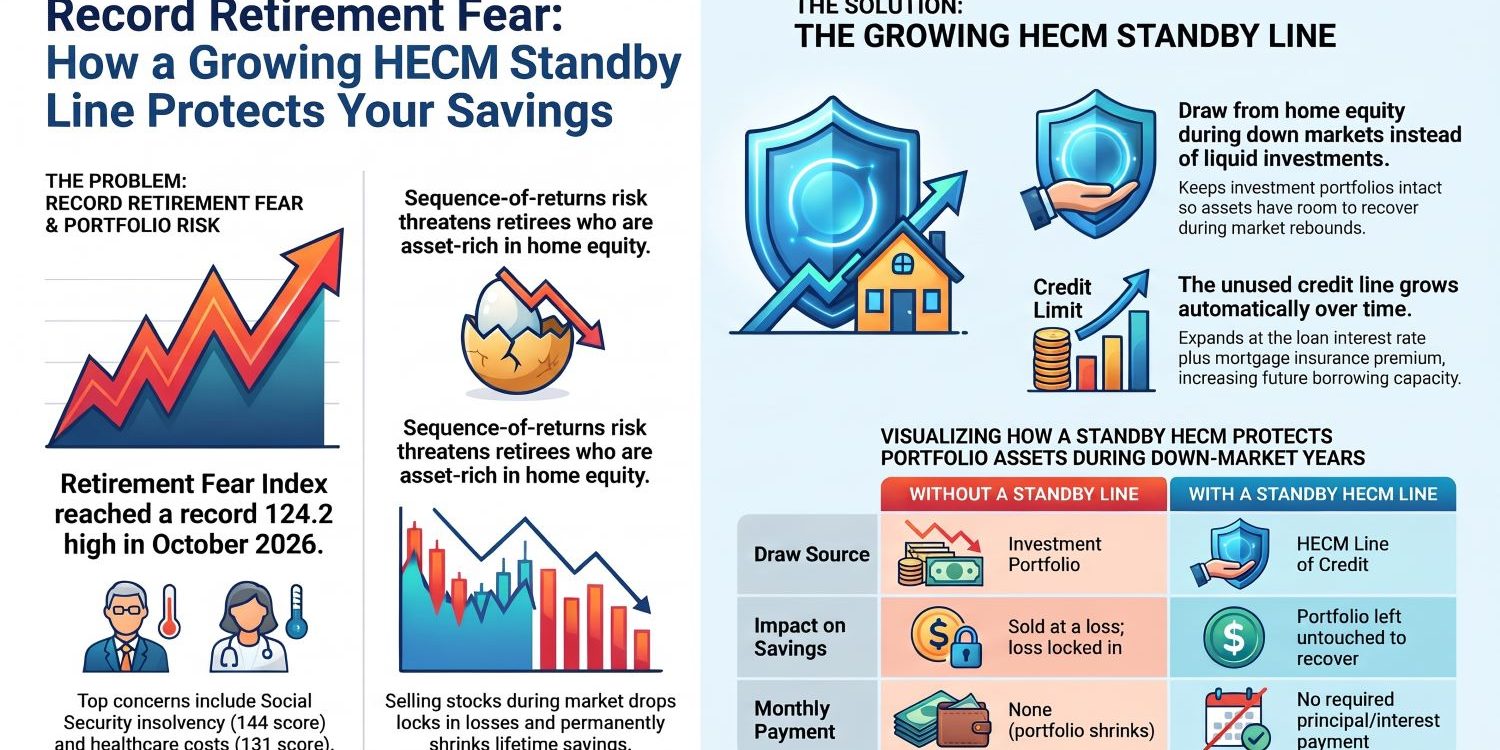
Record-high anxiety. The September RetireMentors Retirement Fear Index hit a record 121.8, meaning overall retirement anxiety is running nearly 22% above the index’s December 2025 baseline. October pushed it higher still, to a new high of 124.2.
Healthcare and long-term care score an intensity of 130, driven by rising medical bills and assisted living costs. Social Security and pension insolvency lead at 146, reflecting widespread fear that future benefit payouts will be reduced or altered.
Meanwhile, market volatility concerns are climbing as retirees worry about watching stock market drops shrink their savings early in retirement.
My reaction when I read these monthly reports is always the same: like we didn’t know this already. Regurgitating survey data doesn’t help a single retiree pay a medical bill or sleep better.
What’s the real problem behind the fear?
Being rich in home equity while your savings absorb every shock. RetireMentors, which publishes the index, says about 70% of these retirement fears can be addressed through planning. If that’s true, let’s stop staring at charts and talk about street-level execution.
Working directly with homeowners and advisors, I see the same issue constantly: people entering retirement asset rich in home equity, while their liquid portfolios take the full beating from inflation and market drops.
When expenses spike or markets dip, retirees are forced to sell stocks at a loss, risking sequence-of-returns depletion, or scrimp on living out of fear.
It’s the danger of a market drop in the early years of retirement, while you’re also withdrawing money. Selling investments after a loss locks the loss in, so less of your savings is left to recover. Two people with the same average returns can end up with very different balances depending on when the bad years fall.
How does a HECM line of credit help?
It gives you a second place to draw from when markets are down. This is where an FHA HECM line of credit becomes a practical, real-life solution. A Home Equity Conversion Mortgage, or HECM, is the FHA-insured reverse mortgage for homeowners 62 and older.
Instead of treating home equity as a last resort option, forward-looking planners establish a HECM line of credit early as a standby pool. It sits anchored to the house and doesn’t rise or fall with Wall Street.
| Without a standby line | With a standby HECM line of credit | |
|---|---|---|
| Where you draw from | Your investment portfolio | The HECM line of credit |
| What happens to your investments | Sold at a loss, locking it in | Left alone, with room to recover |
| Monthly payment on what you draw | None, but your savings shrink | No required principal and interest payment. Interest is added to the loan balance |
| When markets recover | A smaller portfolio has to rebuild | Your portfolio rebuilds. You can repay the line if you choose, which restores the credit |
💡 On a phone? Swipe the table left and right to see every column.
Property taxes, homeowners insurance, HOA or common charges and upkeep stay your responsibility with a HECM, and falling behind on them can make the loan due and payable. You keep the title to your home.
See what a standby line could look like for you. Tell us your age, your town and what you owe on your home. We’ll show you what a HECM line of credit could open at and how it would grow. Get your standby line of credit estimate →
How does the unused line grow?
Here is what most people miss: the growth feature on the unused line. Under FHA rules, whatever portion of the line you leave untouched doesn’t sit static. It actually grows over time at the same compounding rate as the loan’s note rate plus the 0.5% annual mortgage insurance premium.
Your available borrowing power expands year after year, building a larger pool of liquidity for when healthcare or long-term care needs hit later in life. Because HECM line of credit rates are adjustable, how fast it grows depends on where rates go.
| Assumed growth rate | After 5 years | After 10 years | After 15 years |
|---|---|---|---|
| 6% | About $337,200 | About $454,800 | About $613,500 |
| 7% | About $354,400 | About $502,400 | About $712,200 |
| 8% | About $372,500 | About $554,900 | About $826,700 |
💡 On a phone? Swipe the table left and right to see every column.
Illustrative example only, October 2026. Assumes a $250,000 line left completely untouched and a constant growth rate (the loan’s interest rate plus 0.5% mortgage insurance), compounded monthly. Real rates adjust over time, and the amount you can open a line with depends on your age, home value and rates at closing. This is not an offer or a commitment to lend.
During down-market years, instead of draining your retirement savings at the worst time, you draw from your growing HECM standby line. Your investment portfolio gets room to recover, you have more control over when you take taxable withdrawals, and you preserve your hard-earned life savings.
Which retirement fears can a HECM line of credit address?
Several, but not all of them. Here’s an honest look at the fears in the index.
| Fear | Can a HECM line of credit help? | How |
|---|---|---|
| Market volatility | Yes | A second source of funds in down years, so you don’t have to sell investments at a loss |
| Outliving your savings | Yes | A reserve outside your portfolio whose unused portion grows over time |
| Healthcare and long-term care | Partly | Can pay for in-home care, aides and home modifications. It can’t fund a permanent move out of the home |
| Inflation and everyday costs | Partly | Can remove an existing mortgage payment and cover rising costs, but it’s borrowed money that adds to the loan balance |
| Home maintenance | Yes | Pays for repairs without dipping into savings |
| Social Security and pension changes | No | Home equity doesn’t change benefit rules. It can only add another source of cash |
💡 On a phone? Swipe the table left and right to see every column.
What can’t a HECM line of credit do?
It isn’t a fit for everyone, and the rules matter. Before you open one, know these limits:
- The home must stay your primary residence. If you’re away for more than 12 months in a row for medical reasons, such as a permanent move to assisted living, the loan becomes due.
- Any existing mortgage is paid off first. A HECM has to be the only mortgage on the home, so a large balance at a low rate changes the math.
- The rate is adjustable. A HECM line of credit always carries an adjustable rate, which affects how fast both the loan balance and the unused line grow.
- There are upfront costs. FHA mortgage insurance, an origination fee and closing costs make it a poor fit if you plan to move within a few years.
- Taxes and Medicaid need a professional. Loan proceeds generally aren’t treated as income, but how draws affect your taxes or benefits is a question for a tax advisor or elder law attorney.
So what should you do with the fear index?
Use it as a prompt to plan, not a reason to worry. We can keep reading fear indexes, or we can use practical tools to take the anxiety off the table. When you look at home equity as an active buffer rather than a dead asset, those retirement stats lose their power.
Ready to turn your home equity into a retirement buffer?
Homeowners and financial advisors: send us the homeowner’s age, town and current mortgage balance. We’ll show what a standby HECM line of credit could open at, how it could grow, and what it costs. No application and no obligation.
Get your standby line of credit estimate →
Or call Perry at 631-574-1306
HECM line of credit and retirement planning questions
When is the best time to open a HECM line of credit?
Usually earlier rather than later, if a reverse mortgage fits your plans. The unused portion of the line grows over time, so a line opened at 65 and left untouched has more years to grow than one opened at 75. You must be at least 62, live in the home as your primary residence and complete HUD counseling.
Can I pay back a HECM line of credit and use it again?
Yes. You can make voluntary payments at any time without a penalty, and paying down the balance restores that amount to your available line of credit. Some homeowners draw from the line in a down-market year and repay it when their investments recover, keeping the reserve ready for the next downturn.
Does a HECM line of credit affect Social Security or Medicare?
Generally no. Social Security and Medicare are not based on your assets or income from loan proceeds. Means-tested programs are different. Money you draw and hold could count as a resource for Medicaid or Supplemental Security Income, so talk to an elder law attorney before drawing large amounts.
What happens to my line of credit if I move into assisted living?
The home must stay your primary residence. If you live elsewhere for more than 12 months in a row for medical reasons, the loan becomes due, and it is usually repaid by selling the home. A HECM line of credit works best for paying for care at home, such as aides and home modifications.
Will my heirs still inherit the house?
Yes. Your heirs can keep the home by paying off the loan, sell it and keep any remaining equity, or let the lender sell it. A HECM is non-recourse, so they never owe more than the home is worth. To keep the house, they pay the lesser of the loan balance or 95% of the appraised value.
Perry Pappas, NMLS #3771. Jet Direct Funding Corp. DBA Jet Direct Mortgage and Senior Reverse Network, NMLS #3542, Licensed Mortgage Banker, NYS Department of Financial Services. This article is for educational purposes only and is not legal, tax or investment advice. Illustrative figures are examples, not offers. Borrowers must be at least 62, occupy the home as their primary residence, complete HUD-approved counseling, and continue to pay property taxes, homeowners insurance and maintenance. Failure to meet the loan terms can result in the loan becoming due and payable. Equal Housing Opportunity.
This material is not from HUD or FHA and has not been approved by HUD or any government agency.
Sources
- RetireMentors, The Retirement Fear Index, covering the October 2026 reading, category scores, the December 2025 baseline and the 70% planning estimate.
- RetireMentors, Retirement Fear Index: measuring what retirees fear most, covering the September 2026 reading of 121.8.
- U.S. Department of Housing and Urban Development, FHA lender resources, covering HECM program limits.

Perry Pappas is a Senior Vice President of Reverse Mortgage Sales at Jet Direct Mortgage with over 26 years of mortgage industry experience. He specializes in retirement housing strategy, senior liquidity planning, and helping older homeowners evaluate how home equity may fit into long-term financial stability. Perry is known for simplifying complex retirement financing concepts and providing straightforward education around modern reverse mortgage strategies.
Call/Text: 516-851-0696
Jet Direct Mortgage | 4875 Sunrise Hwy, Bohemia, NY 11716
Perry Pappas NMLS #3771 | Jet Direct Mortgage NMLS #3542 | Equal Housing Lender