Reverse Mortgage: A Complete 2026 Guide
Brooklyn homeowners have quietly built enormous wealth in their homes — from brownstones in Park Slope and row houses in Bay Ridge to condos in Williamsburg and single-family homes in Marine Park. A reverse mortgage is one of the few tools that lets older homeowners turn that equity into usable, tax-free cash without selling or taking on a monthly mortgage payment. Here's everything you need to know for 2026.
🔑 Key Takeaways
- A Brooklyn reverse mortgage lets homeowners 62 and older convert equity into tax-free cash with no monthly mortgage payment.
- You keep the title and stay in your home as long as it's your primary residence.
- Three main options exist: the FHA-insured HECM, HECM for Purchase, and jumbo/proprietary loans for higher-value homes.
- The 2026 FHA limit is $1,249,125; many Brooklyn homes exceed it, making jumbo options relevant.
- Eligible property types include single-family, 1–4 units, and FHA-approved condos — co-ops generally don't qualify.
- Loans are non-recourse, require HUD counseling, and include New York consumer protections.
⚡ Quick Answer
A Brooklyn reverse mortgage lets an eligible homeowner borrow against home equity and receive funds as a lump sum, monthly payments, or a line of credit — with no required monthly mortgage payment. You keep the title and stay in your home; the loan is repaid when the home is sold or is no longer your primary residence. Because Brooklyn values are high and its housing mix is diverse, the right option depends on your property type and value — a standard FHA HECM for most homes, or a jumbo loan for higher-value brownstones.
📞 Curious What Your Brooklyn Home Could Unlock?
Talk with a licensed local specialist and get a free, no-obligation estimate tailored to your property.
What Is a Reverse Mortgage?
With a traditional mortgage, you pay the lender every month. A reverse mortgage flips that relationship: the lender pays you, drawing from equity you've already built, with no monthly mortgage payment required. Interest is added to the loan balance over time rather than billed to you, and repayment is deferred until you sell the home, move out permanently, or pass away. Throughout, you remain the owner on the title — the lender simply holds a lien, exactly like any mortgage. Your ongoing responsibilities are the ones you already have: property taxes, homeowners insurance, and basic upkeep.
How much you can access depends on the age of the youngest borrower, your home's appraised value, current interest rates, and the program limits. You can estimate a figure with our reverse mortgage calculator.
Types of Reverse Mortgages Available in Brooklyn
"Reverse mortgage" is an umbrella term. Brooklyn homeowners generally choose among these options, depending on their home's value and goals.
| Type | Best Suited For | What Makes It Different |
|---|---|---|
| HECM (FHA-insured) | Most homeowners with eligible homes up to about $1.25M | The standard, federally-insured reverse mortgage with flexible payouts and strong protections. |
| HECM for Purchase | Those who want to move rather than stay put | Buy a new primary residence and set up the reverse mortgage in one transaction — no monthly payment. |
| Jumbo / Proprietary | Higher-value homes above the FHA limit (common in the brownstone belt) | Privately insured; many programs lend on homes valued up to approximately $4 million, depending on lender guidelines. |
| Single-Purpose | Limited budgets, one specific need | Offered by some government or nonprofit programs for a defined use, such as property taxes or repairs. |
💡 On a phone? Swipe the table left and right to see every column. For a deep dive on the FHA-insured option, see our Brooklyn HECM Mortgage guide.
Brooklyn Values and the 2026 FHA Limit
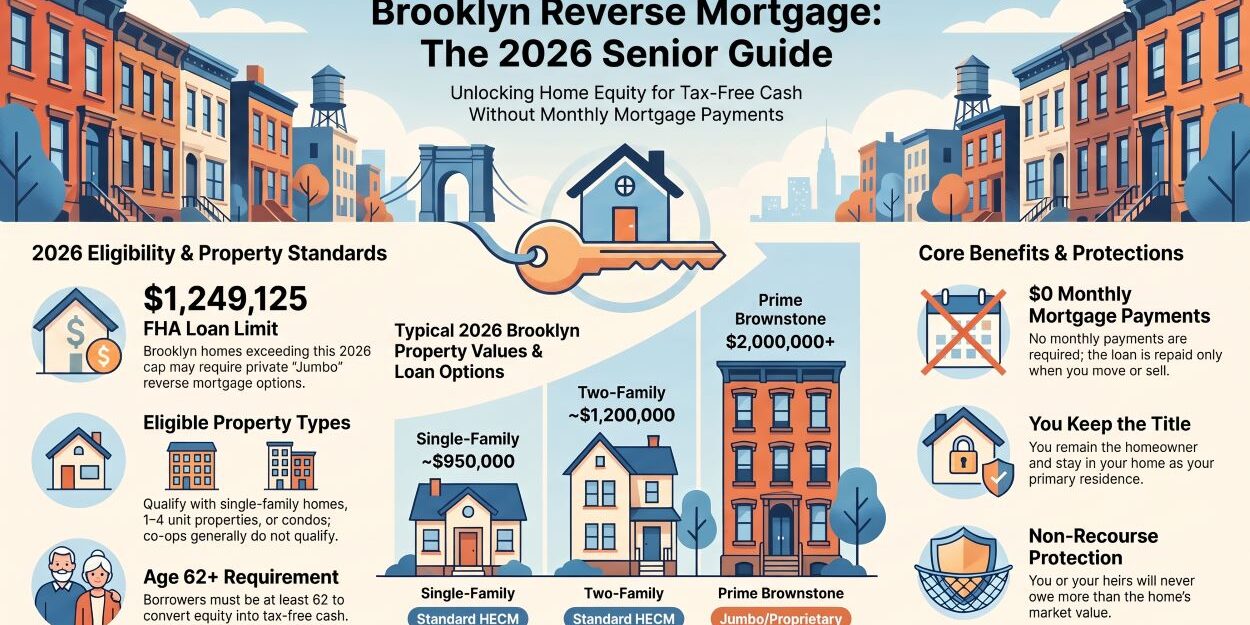
For 2026, the FHA counts home value up to $1,249,125 for a HECM. Many Brooklyn homes fall under that ceiling, but plenty don't — prime brownstones in Park Slope, Cobble Hill, Brooklyn Heights, and Boerum Hill routinely trade well above it. For those homes, a jumbo reverse mortgage can unlock more. Here's how typical Brooklyn values compare (approximate, early 2026):
Approximate median values scaled against the 2026 FHA limit. Prime brownstones ($2M+) exceed the cap, where a jumbo option matters most.
🧮 Not Sure Which Option Fits Your Home?
We'll compare a HECM against a jumbo option for your specific Brooklyn property — in plain English.
Which Brooklyn Homes Qualify?
Property type matters in Brooklyn, where housing is split fairly evenly among co-ops, condos, single-family homes, and two-family houses. Eligible property types include a single-family home, a 2–4 unit property you occupy (ideal for the borough's brownstones and row houses in Bed-Stuy, Crown Heights, and Bay Ridge), and FHA-approved condos in neighborhoods like Williamsburg and Downtown Brooklyn. One key point: standard FHA HECMs are generally not available for co-operative apartments, which are common in Bay Ridge, Bensonhurst, Midwood, and Brighton Beach. If you own a co-op, a HECM usually won't apply.
How Brooklyn Homeowners Use the Funds
There are no restrictions on how you spend the proceeds. The chart below is an illustrative example of common homeowner uses — not a study or statistical claim, and every household is different.
- Property taxes & insurance
- Health & in-home care
- Paying off an existing mortgage
- Standby line of credit
Illustrative example of common homeowner uses only — your allocation depends on your own goals and situation.
Pros and Cons of a Brooklyn Reverse Mortgage
| Advantages | Disadvantages |
|---|---|
| No required monthly mortgage payment | Interest accrues and the balance grows over time |
| Stay in your home and keep the title | You must keep paying property taxes and insurance |
| Flexible line of credit that can grow | The home must remain your primary residence |
| Non-recourse protection | Heirs repay the loan (usually by selling or refinancing) |
| Tax-free proceeds (consult a tax advisor) | Reduces the equity left to your estate |
What It Costs
- A home appraisal to establish market value
- An origination fee (federally capped on HECMs)
- An FHA mortgage insurance premium on HECMs — an upfront amount plus an annual charge
- Standard closing costs (title, recording, and similar)
- An ongoing servicing fee
- A modest fee for the required HUD counseling session
Most of these can be rolled into the loan rather than paid out of pocket, so many homeowners reach closing with little or no cash required.
Built-In Protections
- You keep the title. The lender holds a lien, just like any mortgage — they never own your home.
- It's non-recourse. You and your heirs can never owe more than the home is worth at repayment.
- Independent counseling is required. A HUD-approved counselor reviews everything with you first, and New York emphasizes in-person counseling.
- Right of Rescission. Borrowers receive the federally required three-business-day right to cancel after closing, and New York includes additional consumer protections for reverse mortgage borrowers.
The Process, Step by Step
From first call to funded loan, expect about 30 to 45 days:
- Consultation. A no-pressure conversation to see whether it fits your goals.
- HUD counseling. Your required, independent session.
- Application & appraisal. A professional valuation of your Brooklyn home.
- Underwriting & financial assessment. Final review and approval.
- Closing & funding. Sign, observe the three-day right to cancel, then receive your funds or open your line of credit.
📌 The Bottom Line
- A reverse mortgage converts Brooklyn home equity into tax-free funds with no monthly payment.
- Choose among HECM, HECM for Purchase, and jumbo options based on your home's value.
- Most single-family, 1–4 unit, and FHA-approved condo homes qualify; co-ops usually don't.
- It's non-recourse, and you keep the title throughout.
🏡 Ready to See What Your Brooklyn Home Could Provide?
Get a clear, personalized estimate from a licensed specialist who knows the Brooklyn market — no cost, no pressure, no obligation.
📞 Or call us directly at 866.203.1231
❓ Brooklyn Reverse Mortgage FAQs
How much money can I get from a Brooklyn reverse mortgage?
It depends on the age of the youngest borrower, your home's appraised value, current interest rates, and the FHA limit ($1,249,125 for 2026). Higher-value Brooklyn homes may access more through a jumbo option. A free estimate on your specific home gives an exact figure.
Can I get a reverse mortgage on a Brooklyn co-op?
Generally, no. Standard FHA HECMs are not available for co-operative apartments, which are common in Brooklyn. Single-family homes, 1–4 unit properties, and FHA-approved condos are eligible.
What if my Brooklyn home is worth more than the FHA limit?
Many Brooklyn homes exceed the $1,249,125 cap, especially in the brownstone belt. A jumbo (proprietary) reverse mortgage can account for the higher value, with some programs lending up to approximately $4 million depending on guidelines.
Do I still own my home?
Yes. You remain on the title and stay the owner. The lender holds a lien, just like any mortgage, and the loan is non-recourse — you'll never owe more than the home is worth.
Will it affect my Social Security or Medicare?
Generally, no. Because the proceeds are loan funds rather than income, they typically don't affect Social Security or Medicare. They can affect needs-based programs like Medicaid or SSI, so consult a tax advisor.
What happens to my home when I pass away?
The loan becomes due. Heirs can sell the home, repay the balance, and keep any remaining equity, or refinance to keep the property. Because it's non-recourse, they'll never owe more than the home is worth.
Why Work With Senior Reverse Network
We're a licensed Mortgage Banker with the NYS Department of Financial Services (NMLS #3542), based in Bohemia, NY, and serving homeowners across Brooklyn — from Bay Ridge and Bensonhurst to Park Slope, Bed-Stuy, Canarsie, and Sheepshead Bay — and the wider New York City area. We lead with education, not pressure: we'll confirm whether your home qualifies, compare a HECM against a jumbo option when your value calls for it, run real numbers for your property, walk you through New York's protections, and let you decide on your own timeline.
Explore related guides: Brooklyn HECM Mortgage →, Queens HECM Mortgage →, Staten Island Reverse Mortgage →, and Reverse Mortgage for Seniors in New York →
Data Sources
Home value and market figures in this article are approximate and drawn from publicly reported early-2026 data. Program limits are set by the federal government. Key sources include:
- U.S. Department of Housing and Urban Development (HUD) / FHA — 2026 HECM maximum claim amount ($1,249,125). hud.gov
- NYC Department of Finance — recorded residential property sales for Brooklyn (Kings County). nyc.gov/finance
- Zillow, Redfin, and Realtor.com — Brooklyn home value indices and median list/sale prices (early 2026).
- PropertyShark and Corcoran (Inhabit reports) — Brooklyn median prices by property type (single-family, two-family, condo, co-op).
- Miller Samuel / Douglas Elliman market reports — Brooklyn sales, townhouse, and luxury market data.
Senior Reverse Network is not a government agency, and this guide is for general educational purposes — it is not financial, tax, or legal advice. The content on this page is not from HUD or FHA and is not approved by the Department or any government agency. Reverse mortgages are subject to credit approval and program requirements. The 2026 FHA HECM maximum claim amount is $1,249,125; jumbo/proprietary loan amounts and limits are set by private lenders and vary by program. Property-type eligibility, including co-op and condo rules, is determined by FHA and lender guidelines and can change. Home value figures and charts are approximate, illustrative examples based on publicly reported market data, not statistical claims. Please consult a tax or financial advisor regarding your specific situation. Jet Direct Funding Corp. DBA Jet Direct Mortgage DBA Senior Reverse Network, 4875 Sunrise Hwy, Suite 300, Bohemia, New York 11716. NMLS #3542. Equal Housing Lender.