Queens HECM Mortgage: A Complete Guide for Homeowners
If you own a home in Queens and you're exploring ways to tap your equity in retirement, you've probably come across the term "HECM." It stands for Home Equity Conversion Mortgage — the federally-insured reverse mortgage backed by the FHA, and by far the most common type used across New York. For Queens homeowners sitting on years of appreciation in neighborhoods like Bayside, Forest Hills, Flushing, Astoria, and Jamaica, a HECM can turn that equity into tax-free cash without a monthly mortgage payment.
This guide explains exactly how a Queens HECM mortgage works in 2026 — who qualifies, which Queens property types are eligible (an important point in a borough full of co-ops), how much you can borrow, the ways you can receive your money, what it costs, and how the process unfolds from start to finish.
⚡ Quick Answer
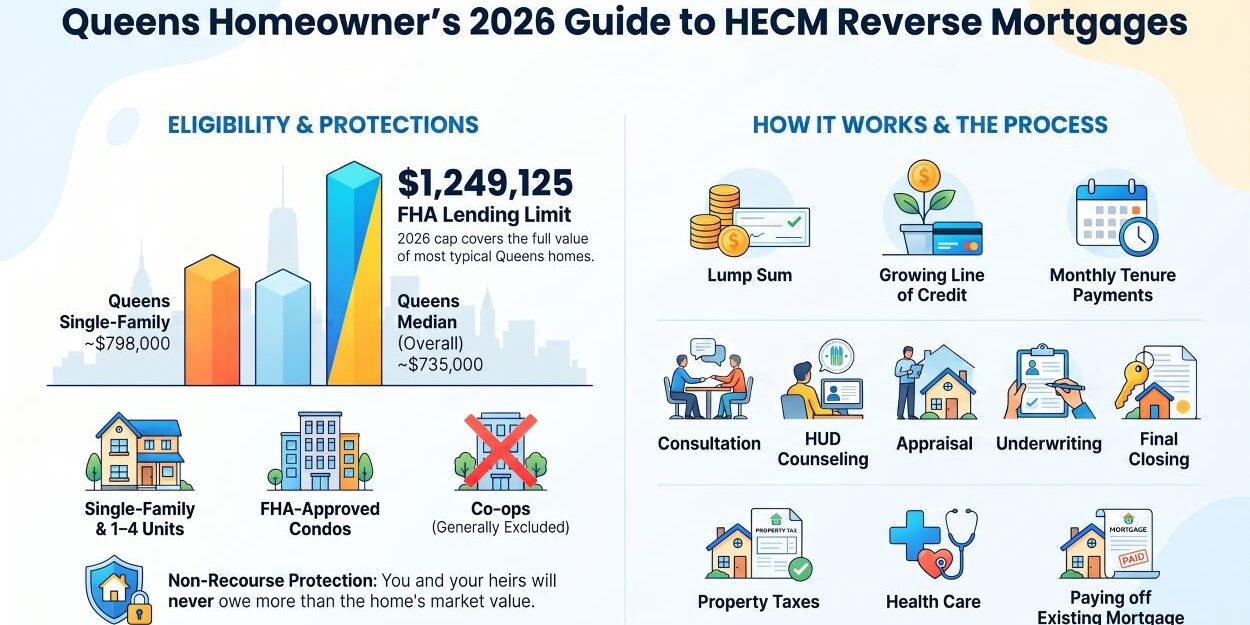
A Queens HECM mortgage is an FHA-insured reverse mortgage that lets an eligible homeowner borrow against home equity and receive funds as a lump sum, line of credit, or monthly payments — with no required monthly mortgage payment. You keep the title and stay in your home; the loan is repaid when the home is sold or is no longer your primary residence. In 2026 the FHA counts home value up to $1,249,125, and the home must be an eligible property type (single-family, 1–4 units, or an FHA-approved condo — generally not a co-op).
🔑 Key Takeaways
- A HECM is the FHA-insured reverse mortgage — the standard option in Queens.
- The 2026 FHA limit is $1,249,125; higher-value homes may need a jumbo loan instead.
- Queens co-ops generally don't qualify for a HECM; condos must be FHA-approved.
- You choose how to receive funds: lump sum, line of credit, or monthly income.
- It's non-recourse, requires HUD counseling, and you keep the title.
📞 Wondering If Your Queens Home Qualifies?
Talk with a licensed local specialist and get a free, no-obligation HECM estimate tailored to your property.
What Is a HECM?
A Home Equity Conversion Mortgage is a loan that lets older homeowners convert part of their home equity into cash. Unlike a traditional mortgage where you pay the lender each month, with a HECM the lender pays you — and there's no monthly mortgage payment. Interest is added to the balance over time rather than billed to you, and the loan isn't repaid until you sell the home, move out permanently, or pass away.
Because it's insured by the Federal Housing Administration, a HECM comes with strong consumer protections: it's non-recourse (more on that below), it requires independent counseling before you commit, and it follows standardized federal rules. Throughout the loan, you remain the owner on the title — the lender simply holds a lien, exactly like any mortgage.
HECM vs. Other Reverse Mortgages
"Reverse mortgage" is an umbrella term. The HECM is the FHA-insured version, but it helps to see where it sits among the options available in Queens.
| Type | Insured By | Best Suited For |
|---|---|---|
| HECM | FHA (federal) | Most Queens homeowners with eligible homes up to about $1.25M |
| HECM for Purchase | FHA (federal) | Those who want to buy a different home and set up a reverse mortgage at once |
| Jumbo / Proprietary | Private lender | High-value homes above the FHA limit; can reach up to $4 million |
💡 On a phone? Swipe the table left and right to see every column.
Which Queens Homes Qualify for a HECM?
This matters more in Queens than almost anywhere, because the borough has so many co-operative apartments. Eligible property types for a HECM include:
- A single-family home you occupy as your primary residence
- A 2–4 unit property where you live in one of the units
- An FHA-approved condominium (or a unit that qualifies under single-unit approval)
- Certain manufactured homes that meet FHA requirements
Important for Queens: Co-ops & HECMs
Standard FHA HECMs are generally not available for co-operative apartments — and Queens has a large number of co-ops in areas like Forest Hills, Rego Park, and Jackson Heights. If you own a co-op, a HECM usually won't be an option, though other equity strategies may exist. If you own a condo, confirm whether the building is FHA-approved.
2026 HECM Limits and Queens Home Values
For 2026, the FHA caps the home value it will count for a HECM at $1,249,125. Most Queens homes fall comfortably under that ceiling, which means the program can account for the full value. Homes worth more would look to a jumbo/proprietary option. Here's how typical Queens values compare against the cap (approximate, early 2026):
Approximate values scaled against the 2026 FHA limit. Most Queens homes sit under the cap.
🧮 Curious How Much You Could Access?
We'll run the numbers for your specific Queens property and explain your options in plain English.
How You Can Receive Your Money
One of the HECM's biggest advantages is flexibility in how you take the proceeds. You can choose one option or combine several.
Lump Sum
A single disbursement at closing — often used to pay off an existing mortgage or a large expense.
Line of Credit
Draw funds as needed; the unused portion grows over time, building a larger safety net.
Tenure Payments
Equal monthly payments for as long as you live in the home as your primary residence.
Term Payments
Equal monthly payments for a set number of years that you choose.
Combination
Mix a line of credit with monthly payments to fit your specific cash-flow needs.
How Queens Homeowners Use a HECM
There are no restrictions on how you spend the funds. The illustrative breakdown below reflects how proceeds are commonly directed — every household is different.
- Property taxes & insurance — 30%
- Health & in-home care — 25%
- Paying off an existing mortgage — 25%
- Standby line of credit — 20%
Illustrative example only — your allocation depends on your own goals and situation.
What a HECM Costs
A HECM carries costs similar in nature to a traditional mortgage, plus FHA insurance that funds its protections. The main ones include:
- A home appraisal to establish market value
- An origination fee (federally capped on HECMs)
- An FHA mortgage insurance premium — an upfront amount plus an annual charge
- Standard closing costs (title, recording, and similar)
- An ongoing servicing fee
- A modest fee for the required HUD counseling session
Most of these can be rolled into the loan rather than paid out of pocket. As part of approval, lenders also complete a financial assessment; in some cases a portion of the proceeds is set aside (a "Life Expectancy Set-Aside") to cover future property taxes and insurance. A reputable lender will give you a clear, itemized breakdown before you commit.
HECM Protections
- You keep the title. The lender holds a lien, just like any mortgage — they never own your home.
- It's non-recourse. You and your heirs can never owe more than the home is worth at repayment; FHA insurance covers any shortfall.
- Independent counseling is required. A HUD-approved counselor reviews everything with you first — and New York emphasizes the availability of in-person counseling.
- Proceeds are generally tax-free and typically don't affect Social Security or Medicare (consult a tax advisor).
Who Qualifies in Queens
To qualify for a HECM, all borrowers on the title must be 62 or older, the home must be your primary residence in Queens and an eligible property type, it must meet FHA condition standards, and you must hold sufficient equity. You'll also complete the required counseling session and a financial assessment. New York's strong consumer-protection rules — including a 3-day right to cancel after you sign the commitment — apply on top of the federal HECM safeguards.
The HECM Process, Step by Step
From first call to funded loan, expect about 30 to 45 days, moving through a few clear phases:
- Consultation. A no-pressure conversation to see whether a HECM fits your goals.
- HUD counseling. Your required, independent session.
- Application & appraisal. A professional valuation of your Queens home.
- Underwriting & financial assessment. Final review and approval.
- Closing & funding. Sign, observe the 3-day cancellation window, then receive your funds or open your line of credit.
📌 The Bottom Line
- A HECM is the FHA-insured reverse mortgage and the standard choice in Queens.
- The 2026 limit is $1,249,125; most Queens homes fall under it.
- Eligible homes include single-family, 1–4 units, and FHA-approved condos — not co-ops.
- Receive funds as a lump sum, line of credit, or monthly income.
- It's non-recourse, requires counseling, and you keep the title.
🏡 Ready to See What Your Queens Home Could Provide?
Get a clear, personalized HECM estimate from a licensed specialist who knows the Queens market — no cost, no pressure, no obligation.
📞 Or call us directly at 866.203.1231
❓ Queens HECM FAQs
What is a HECM mortgage?
A HECM (Home Equity Conversion Mortgage) is the FHA-insured reverse mortgage. It lets an eligible homeowner borrow against home equity with no monthly mortgage payment, while keeping the title and living in the home until it's sold or is no longer their primary residence.
Can I get a HECM on a Queens co-op?
Generally, no. Standard FHA HECMs are not available for co-operative apartments, which are common in Queens. Single-family homes, 1–4 unit properties, and FHA-approved condos are eligible. If you own a co-op, ask a specialist whether any other equity options apply.
What is the 2026 HECM limit?
The 2026 FHA maximum claim amount for a HECM is $1,249,125. Homes worth more may benefit from a jumbo or proprietary reverse mortgage, which can go up to $4 million.
How can I receive my HECM funds?
You can take a lump sum, a line of credit (the unused portion grows over time), tenure payments (monthly for as long as you live in the home), term payments (monthly for a set period), or a combination.
Do I still own my home with a HECM?
Yes. You remain on the title and stay the owner. The lender holds a lien, just like any mortgage, and the loan is non-recourse — you'll never owe more than the home is worth.
Will a HECM affect my Social Security or Medicare?
Generally, no. Because the proceeds are loan funds rather than income, they typically don't affect Social Security or Medicare. They can affect needs-based programs like Medicaid or SSI, so consult a tax advisor.
Why Work With Senior Reverse Network
We're a licensed Mortgage Banker with the NYS Department of Financial Services (NMLS #3542), based in Bohemia, NY, and serving homeowners across Queens and the wider New York area. We lead with education, not pressure: we'll confirm whether your home qualifies, explain your HECM options, run real numbers for your property, walk you through New York's protections, welcome your family into the conversation, and let you decide on your own timeline.
Explore related guides: Queens Reverse Mortgage →, Reverse Mortgage for Seniors in New York →, Long Island Reverse Mortgage →, and Nassau County Guide →
Senior Reverse Network is not a government agency, and this guide is for general educational purposes — it is not financial, tax, or legal advice. The content on this page is not from HUD or FHA and is not approved by the Department or any government agency. Reverse mortgages are subject to credit approval and program requirements. The 2026 FHA HECM maximum claim amount is $1,249,125; jumbo/proprietary limits are set by private lenders. Property-type eligibility, including co-op and condo rules, is determined by FHA and lender guidelines and can change. Home value figures and charts are approximate, illustrative examples based on publicly reported market data, not statistical claims. Please consult a tax or financial advisor regarding your specific situation. Jet Direct Funding Corp. DBA Jet Direct Mortgage DBA Senior Reverse Network, 4875 Sunrise Hwy, Suite 300, Bohemia, New York 11716. NMLS #3542.