If you have ever felt that a reverse mortgage sounds too good to be true, or that the companies offering one must be up to something, you are not alone. New York State agrees with you enough to have written it into law. Before any reverse mortgage can close here, the lender has to slow down, hand you the facts in large print, send you to an independent counselor who does not work for them, and wait while you think it over. This guide explains those rules in plain English.
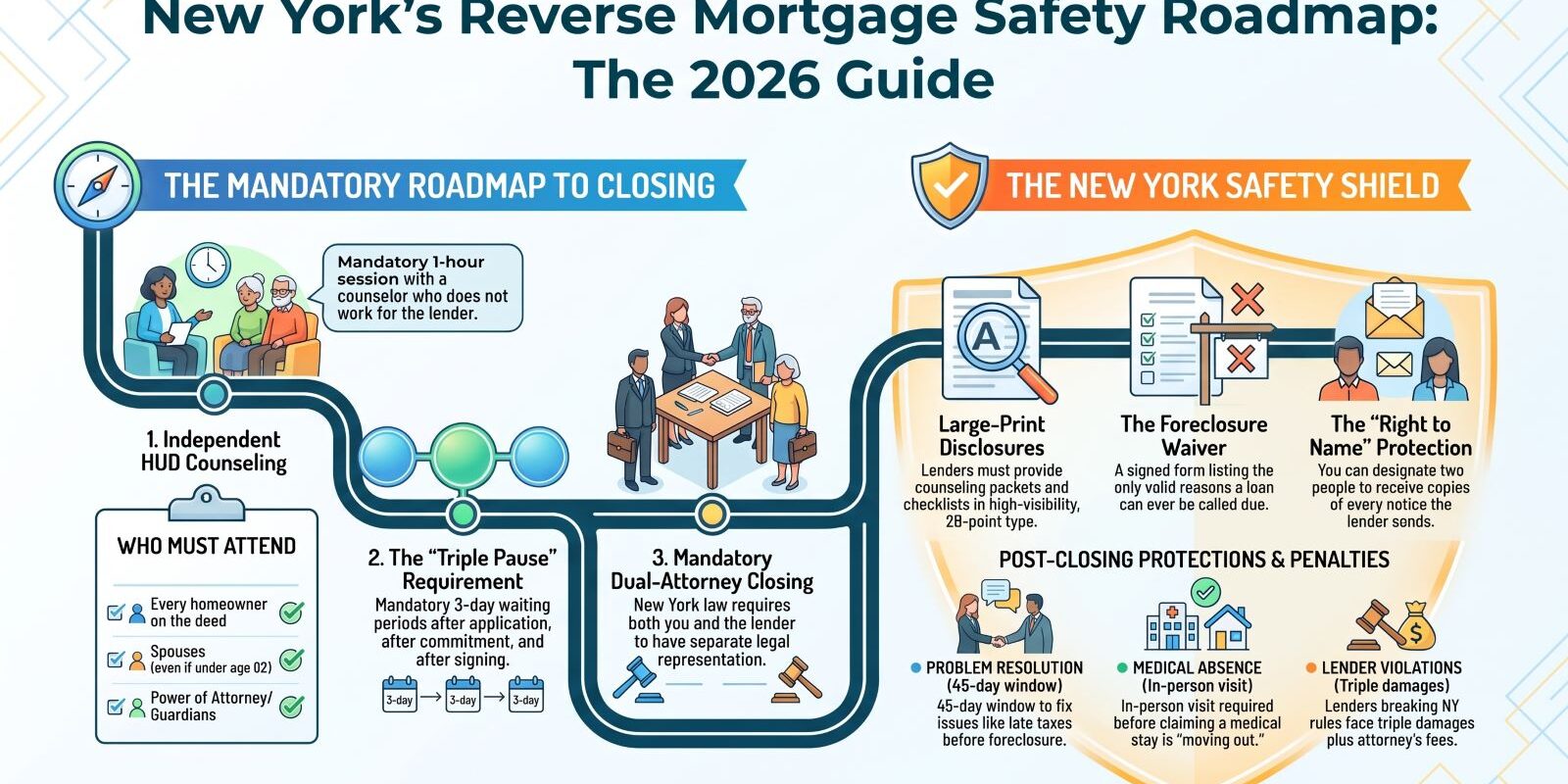
Yes, reverse mortgage counseling is required in New York, and it cannot be skipped. Before your application can move forward, you meet with a HUD-approved counselor who is independent of the lender, by phone or in person. New York then adds its own protections: a counseling packet in large type, two separate three-day waiting periods, and a lawyer for you at closing. None of these can be waived.
Key takeaways
- The counselor does not work for the lender. That is the whole point. Their job is to make sure you understand the loan and to talk through alternatives.
- Everyone whose home it is must attend: you, your spouse (even if they are under 62), and anyone else on the deed.
- New York gives you two built-in pauses, three days after you apply and three days after you sign the commitment, so nobody can rush you.
- You have your own attorney at closing. So does the lender. New York requires both.
- You keep the title to your home. You still pay property taxes, homeowners insurance, and upkeep, and the home stays your primary residence.
📞 The first step is a conversation with someone who is not us
HUD keeps a list of approved reverse mortgage counselors. You can also call the HUD referral line at 800-569-4287. If you would like help understanding what to expect on that call, we are happy to explain it.
Find a HUD counselor near you Contact usWhy does New York make you talk to a counselor first?
Because a reverse mortgage is a serious decision about your home, and the state wants you to hear about it from someone with nothing to sell. That is the honest answer, and it is one we agree with.
Reverse mortgages earned a bad reputation in the years before today's rules existed. Some lenders advertised them like a government benefit. Some steered people into annuities. Some closed loans with a spouse left off the paperwork. Those stories were real, and they are why the rules on this page were written, first by HUD in Washington and then, more strictly, by New York in Albany. Today three layers of rules stand between you and a bad decision.
Each layer adds to the one above it. Nothing in New York's rules takes away a federal protection.
We will say it plainly: a lender who treats these rules as red tape is telling you something. A lender who walks you through them before you ask is telling you something too.
What actually happens in a counseling session?
You spend about an hour with a HUD-approved counselor, by phone or in person, and they explain the loan, the costs, the alternatives, and what would happen to your family. At the end you receive a signed certificate. Without it, no lender in New York can move your application forward.
Who has to be there
Everyone whose home it is: each borrower, your spouse even if they are under 62 and will not be on the loan, and anyone else on the deed. If you are 74 and your wife is 60, she cannot be a borrower, but she must sit in on counseling, and the counselor must explain exactly what she would need to do to stay in the home after you are gone.
What the counselor covers
- How the loan works, including the fact that the balance grows over time because interest and FHA insurance are added to it instead of being paid monthly
- What you must keep doing: paying property taxes and homeowners insurance, keeping the home in repair, and living in it as your primary residence
- What would make the loan come due, and what "non-recourse" means: neither you nor your heirs can ever owe more than the home is worth
- Alternatives, including selling, a home equity line, or local assistance programs
- For a spouse who is not a borrower: exactly what they must do to remain in the home
New York also hands you a printed checklist of questions to raise, in 28-point type. It asks you to think through what an unexpected medical event would mean, how you would pay for assisted living someday, and whether anyone has suggested putting the money into an annuity. If anyone ever does, stop and call a counselor or an attorney.
Phone or in person, and what it costs
For an FHA-insured HECM, you can choose either. For a proprietary (non-FHA) reverse mortgage, New York expects in-person counseling unless you sign a written waiver. If you or your spouse have any hearing difficulty or any doubts, do it in person. Agencies may charge a modest fee, typically $125 to $200 on Long Island [VERIFY], and must reduce or waive it if you cannot afford it. The lender is not allowed to pay it for you. That independence is the point.
Not sure which agency to call? We keep a current copy of the state-approved counselor list and can tell you which Long Island agencies are booking quickly this month. Contact us and we will send it over, with no application required.
What paperwork does the lender have to give you?
A counseling packet the moment you apply, a notice before you sign the commitment, and a signed form at closing that lists every reason the loan could ever be called due. Here is what each one means in plain terms.
Keep every one of these. If any is missing from your file, the lender has a compliance problem, and under New York law that can become a complete defense if anyone ever tried to foreclose.
What are the two built-in waiting periods?
Three days after you apply, and three days after you sign the commitment. Nobody can ask you to move faster, and you cannot sign those rights away. Most states rely only on the federal cancellation right after closing. New York adds two more, earlier, when changing your mind costs you nothing.
- Counseling You meet the counselor and receive your certificate. Required before anything else can happen.
- Application You apply and receive the counseling packet.
- Pause one: 3 days The lender cannot ask you to sign a commitment. Cannot be waived. A good time to call your counselor with follow-up questions.
- Appraisal and approval The home is appraised and the lender issues a written commitment.
- Pause two: 3 days You may cancel, and you cannot be required to close. Cannot be waived.
- Closing Both sides have an attorney present. You sign the foreclosure-waiver form.
- Pause three: 3 business days (federal) On a refinance, you can still cancel after signing. Does not apply to a purchase.
- Funding Your proceeds are disbursed or your line of credit opens.
These pauses rarely add more than a week. What they add is a protected moment to change your mind. We have had clients use it, and we would rather lose a closing than have someone close with doubts.
Why do both sides have a lawyer at closing?
Because New York law says so, and because it means someone who answers only to you reads every page before you sign it. Ask your attorney whether they have closed a reverse mortgage before; if not, have them speak with your loan officer before the closing date, not on it. Your attorney's fee is a closing cost, and on a refinance it can usually be paid from the loan itself.
What protections keep working after you close?
The rules before closing protect you from a bad decision. The rules after closing protect you from a bad servicer. New York's are specific, and a lender or servicer who ignores them cannot foreclose.
Two of these matter most for Long Island families. The first is naming someone. Nassau and Suffolk property tax bills are large, and a missed tax bill is the single most common way a reverse mortgage gets into trouble. A copy of every notice going to an adult child is the cheapest insurance there is. Name one. Our guide to paying Nassau and Suffolk property taxes with home equity covers how a set-aside can handle the bill for you.
The second is what happens if you ever go into rehab or a nursing home for a stretch. New York does not treat a medical stay like moving out. Before any lender could claim you no longer live in the home, they must call you, visit in person, and then wait at least 30 days. If you show you still live there, that is the end of it.
Already have paperwork from another lender?
If something in it does not match what you have read here, send it to us. We will tell you what is missing, at no charge and with no obligation to work with us.
Contact us Find a HUD counselor near you📞 Or call 866.203.1231
The part nobody else puts on the homepage: what it costs, and how it's repaid
Both are things a counselor will walk through, and both are things we would rather you hear from us first.
What it costs
Like any mortgage, a reverse mortgage has costs. There are fees for things like the appraisal, closing, origination, and FHA mortgage insurance.
The good news is that many of these costs can be financed rather than paid out of pocket.
We'll go through every cost with you upfront, so you know exactly what you're getting into before you make a decision.
How it's repaid
A reverse mortgage is designed to let you stay in your home without making monthly mortgage payments, as long as you continue to meet the loan requirements.
The loan generally becomes due when the last surviving borrower sells the home, permanently moves out, or passes away.
If the loan does become due, the home can be sold to repay it, or you or your heirs may have other options. And with an FHA-insured HECM, you and your heirs are protected from personal liability beyond the value of the home.
If one spouse is not a borrower on the reverse mortgage, HUD rules may allow that surviving spouse to remain in the home after the borrowing spouse passes away, provided the requirements are met. That's an important benefit, and one we make sure you understand before you make a decision.
HECM for Purchase (H4P)
Buying your next home? There's a third option.
Most buyers over 62 think they have two choices: pay all cash, or take a conventional mortgage and a monthly payment into their eighties. There's a third. HECM for Purchase lets you buy a home using a down payment plus a reverse mortgage — with no required monthly principal and interest payment.*
- Your down payment is based on your age. The older the youngest borrower, the less you put down. It typically lands somewhere between roughly a third and two-thirds of the purchase price.
- No required monthly P&I payment.* You still cover property taxes, insurance, and upkeep, and the home has to stay your primary residence.
- The rest of your cash stays yours. Money you don't put into the down payment stays in the bank or in your portfolio, where it keeps working.
Every rule on this page applies to a purchase too. The only difference is that counseling needs to be done before you sign a contract. Our Long Island HECM for Purchase guide lays out that schedule.
Ask About HECM for PurchaseOlder buyer, smaller down payment
Roughly how the required down payment moves with age.
Illustration only. Your actual required down payment depends on the age of the youngest borrower, current interest rates, HUD principal limit factors, and the purchase price. We'll run your exact figures before you make any decision.
*You must still pay property taxes, homeowners insurance, any HOA or common charges, and maintain the home as your primary residence. Failure to do so may cause the loan to become due and payable.
How can you tell a lender is playing straight?
Watch what they do before you have signed anything. New York law bars lenders from making a reverse mortgage sound like a government benefit. A HECM is insured by FHA, which is true and matters. It is also a loan, sold by a lender, for a profit. We are required to be clear about that, and we would be even if we weren't.
✅ Good signs
- They give you the counselor list before asking for anything else
- The counseling statement arrives in visibly large type
- They mention both waiting periods without being asked
- They ask who you want named to receive notices
- They ask whether your attorney has closed a HECM before
- They walk through every cost before you apply
⚠️ Reasons to slow down
- Anyone calls the counseling "a formality" or offers to "handle it"
- Marketing that mentions a government "program" or "benefit"
- A suggestion that the money go into an annuity or insurance product
- Pressure to sign during either waiting period
- Your spouse is told they do not need to be involved
- Costs are described as "nothing out of pocket" without explaining they are added to the loan
Related New York reverse mortgage guides
📌 The bottom line
- New York requires independent counseling before a reverse mortgage, and for a HECM it cannot be skipped. That is a feature, not an obstacle.
- Your spouse and anyone on the deed must attend. Bring the family member who helps with your finances.
- You get large-print paperwork, two waiting periods, and your own attorney at closing.
- After closing you have 45 days to fix any problem, and the right to have every notice copied to someone you trust. Name someone.
- Lenders who break these rules face triple damages and lose the right to foreclose. The careful ones treat the rules as the product.
🏡 Start with counseling. We will help with the rest.
Whether you are ready to apply or just want to understand what you would be signing, the first step is the same. Book a session with a HUD-approved counselor, then call us with your questions. No cost, no pressure, no obligation.
Find a HUD counselor near you Contact us📞 Or call us directly at 866.203.1231
Why work with Senior Reverse Network
We are a licensed Mortgage Banker with the NYS Department of Financial Services (NMLS #3542), based in Bohemia and serving Long Island and the five boroughs for 26 years in reverse mortgages only. When you call, you reach a licensed originator, not a call center. We do not treat New York's rules as an obstacle; they are the reason a careful homeowner can consider this loan at all.
Reviewed by Perry Pappas, Senior Vice President of Reverse Mortgage Sales and Licensed Reverse Mortgage Specialist, Senior Reverse Network (Jet Direct Mortgage, NMLS #3542; Perry Pappas NMLS #3771). Published September 2026 · Last reviewed September 2026. This guide is educational. It explains how New York's rules generally work and is not legal, tax or financial advice.
Sources
- New York State Department of Financial Services, Reverse Mortgages — counseling rules, spouse provisions, approved counselor list.
- New York Real Property Law §280-b — advertising limits, attorneys at closing, occupancy visits, triple damages.
- New York Codes, Rules and Regulations, 3 NYCRR §79.9 — counseling packet, checklist, both three-day periods.
- New York Codes, Rules and Regulations, 3 NYCRR §79.7 — 45-day cure, foreclosure waiver form, designees, nursing home exception.
- U.S. Department of Housing and Urban Development, 24 CFR §206.41 — who must be counseled and what is covered; HUD Housing Counseling locator.
Senior Reverse Network is not a government agency, and this guide is for general educational purposes. It is not legal, tax or financial advice. New York and federal requirements are summarized in general terms and can change; consult an attorney or a HUD-approved counselor about your specific situation. This material is not from HUD or FHA and has not been approved by HUD or any government agency. Reverse mortgages are subject to credit approval and program requirements. Borrowers retain title and remain responsible for property taxes, homeowners insurance, HOA or common charges and maintenance; failure to meet those obligations may cause the loan to become due and payable. Jet Direct Funding Corp. DBA Jet Direct Mortgage DBA Senior Reverse Network, 4875 Sunrise Hwy, Suite 300, Bohemia, New York 11716. NMLS #3542. Equal Housing Lender.