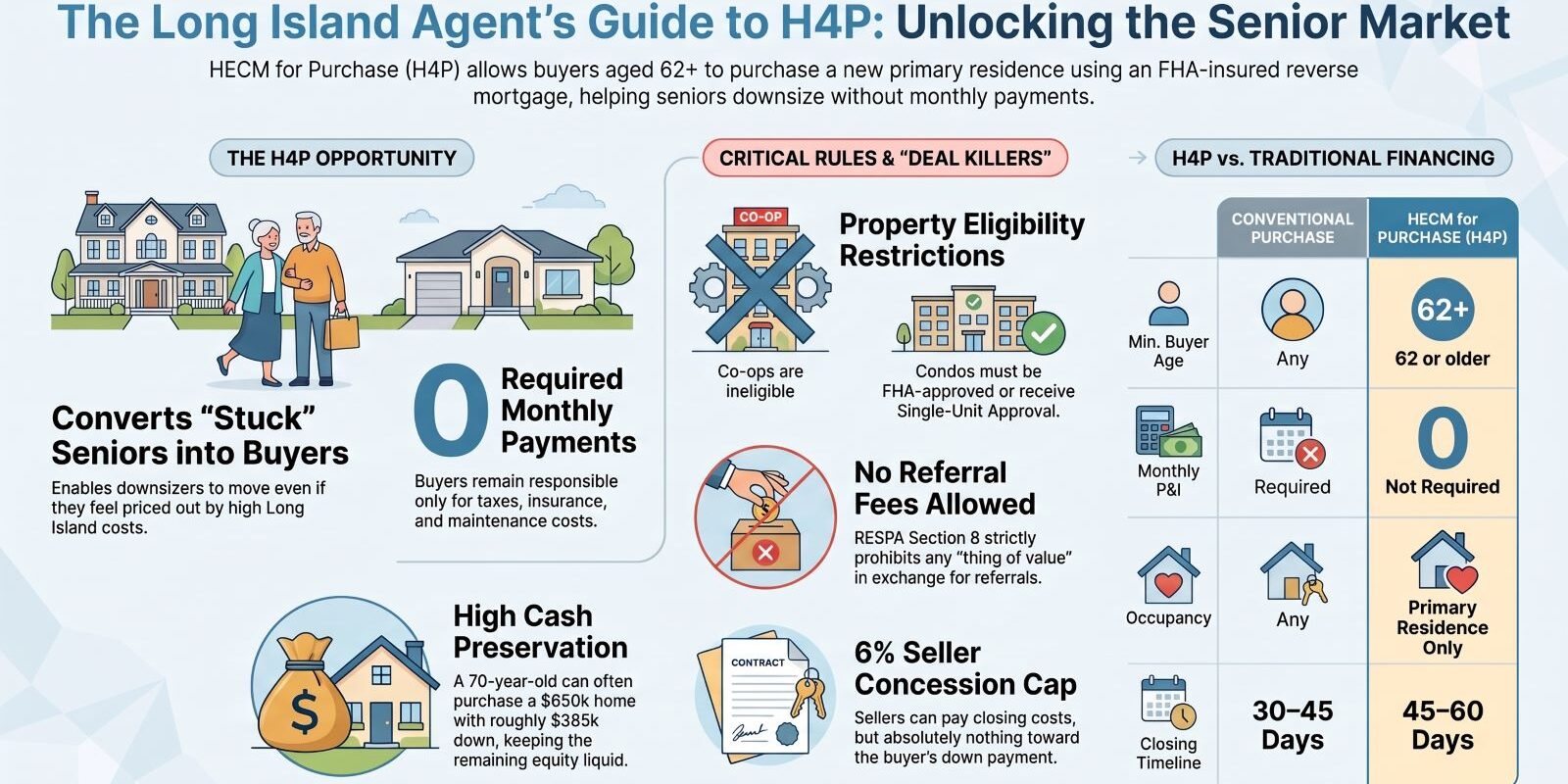
HECM for Purchase lets a buyer 62 or older combine one large down payment with an FHA-insured reverse mortgage to buy a home in a single closing, with no required monthly principal and interest payment. For agents it converts stuck Long Island downsizers into buyers. Taxes, insurance and upkeep stay the buyer's obligation.
Key takeaways for agents
- It creates buyers you are currently losing. The client who prices a 55+ condo, looks at their equity and decides they cannot move is often financeable.
- The seller can contribute up to 6% toward closing costs, but nothing toward the buyer's down payment. Commissions sit outside that cap.
- Co-ops are ineligible and unapproved condos kill deals. Check FHA project status before your buyer writes an offer, not after the deposit is at risk.
- Contracts should say the financing is an FHA-insured reverse mortgage. Attorneys who assume a conventional loan create avoidable problems.
- No lender may pay you for a referral. RESPA Section 8 prohibits it, the penalties reach both sides, and there is no dollar amount that is automatically safe.
Why should a Long Island agent care about H4P?
Because it turns a dead conversation into a transaction. You have had this client. They own a Levittown or Hicksville ranch free and clear, the stairs are getting hard, and they want a newer place in a 55+ community in Plainview or Melville.
Then they price one at $750,000, look at their equity, and conclude that moving means either draining their retirement savings to pay cash or taking on a mortgage payment on a fixed income. So they stay. You lose two sides of a transaction, and they stay in a house that no longer works for them.
HECM for Purchase sits between those two options. The buyer brings a large down payment, an FHA-insured Home Equity Conversion Mortgage covers the balance, and they take title at closing with no required monthly principal and interest payment. They keep more of their cash and they get the house.
For your business the effect is straightforward. A buyer who was priced out at $750,000 all-cash may be able to transact at $750,000 with roughly $444,000 down at age 70, keeping the rest. That is a listing sold and a buyer served who would otherwise have stayed put.
Illustrative example only, September 2026. Down payment percentages depend on the youngest borrower's age, the expected rate at lock and the FHA lending limit, and they move whenever rates move. The consumer guide linked below carries the full table and its assumptions.
How does an H4P deal differ from the purchase I am used to?
Less than you would expect. It is one closing, one title transfer, and your client's name goes on the deed exactly as with any other financed purchase. What changes is the underwriting, the property rules and the front end of the calendar.
| Conventional purchase | HECM for Purchase | |
|---|---|---|
| Buyer age | Any | 62 or older, calculated on the youngest borrower |
| Down payment | Typically 5% to 20% | Roughly 46% to 65%, set by age and rates |
| Monthly principal and interest | Required | Not required |
| Who takes title | The buyer | The buyer, identically |
| Occupancy | Primary, second home or investment | Primary residence only, certified annually |
| Property eligibility | Broad, including co-ops | Single-family, FHA-approved condo, townhouse, 2–4 unit owner-occupied. No co-ops |
| Counseling | None | HUD-approved counseling required before the file proceeds |
| Typical timeline | 30–45 days | 45–60 days |
💡 On a phone? Swipe the table left and right to see every column.
After closing, your client remains responsible for property taxes, homeowners insurance, HOA or common charges and maintenance, and falling behind on those can make the loan due and payable. Worth saying to buyers plainly, because it is the obligation they most often underestimate.
What can my seller contribute, and what can they not?
Up to 6% of the sales price or appraised value, whichever is lower, toward the buyer's closing costs. Nothing at all toward the down payment. That second half is where deals go wrong, because it is the opposite of what many agents assume from FHA forward loans.
| Inside the 6% cap | Outside the cap | Never permitted |
|---|---|---|
| Origination and lender fees | Real estate commissions | Any contribution toward the required down payment |
| Appraisal and title charges | Home warranties | Borrowed funds of any kind as down payment |
| Prepaid taxes and insurance | A personal loan, credit card advance or bridge loan | |
| Discount points | An unsecured line of credit from a relative | |
| The initial FHA mortgage insurance premium | Borrowed money presented as a gift |
💡 On a phone? Swipe the table left and right to see every column.
Acceptable down payment sources are the buyer's own: proceeds from selling their current home, verified savings and investment accounts, documented gifts from family, employer relocation assistance and certain disaster-relief grants. A gift is fine. A loan dressed as a gift is not, and underwriting is good at telling the difference.
Most H4P buyers here are selling one house to buy another, and the sale proceeds are the down payment. That makes the two transactions dependent on each other. Flag it to both attorneys at contract, and make sure the buyer's attorney knows the financing is an FHA-insured reverse mortgage rather than a conventional loan.
Which Long Island listings will kill an H4P deal?
Four categories, and on this island the first two account for most of the failures. Screen for them before your buyer falls in love with a unit.
| Property type | Eligible? | What you need to check |
|---|---|---|
| Single-family detached | Yes | Standard appraisal. Required repairs generally must be done before closing |
| Townhouse (fee simple) | Yes | HOA financials are reviewed where there is a common-interest structure |
| 2–4 unit | Yes | Buyer must occupy one of the units as their primary residence |
| Condominium | Only if FHA-eligible | Full project approval, or Single-Unit Approval for that one unit. Check before the offer |
| Cooperative | No | Nothing to check. Co-ops remain ineligible and no lender can work around it |
| New construction | Not until complete | A certificate of occupancy must be issued before the loan can fund |
| Second home or investment | No | Primary residence only. Not a Montauk weekend house or a Florida rental |
💡 On a phone? Swipe the table left and right to see every column.
The condo approval problem, in the order you should work it
Many Long Island condo and townhome communities have never sought FHA approval, because their sales have historically been cash or conventional. This is the single most common reason an H4P purchase collapses, and almost nobody hears about it until they are already in contract.
- Get the exact legal project name and address from the listing agent, not the marketing name on the sign.
- Have the lender check it against HUD's condominium approval list before your buyer makes an offer. This costs nothing.
- If it is not approved, ask whether Single-Unit Approval is realistic. That depends on the association's reserves, owner-occupancy ratio, delinquency rate and any planned special assessment, and the association will have to produce documents.
- If neither path works, steer to a different community now, weeks before a deposit is at risk.
Send us an address before you write the offer. We will check the project's FHA status and tell you within a day whether it is approvable, including when the answer is no. There is no cost and no obligation on either side. Ask us to check a project →
What belongs in the contract?
Nothing exotic, but a few things that a standard Long Island contract will not contain unless someone adds them.
- Name the financing accurately. The contract and the attorneys should reflect that this is an FHA-insured reverse mortgage, not a conventional loan. Attorneys who assume otherwise write timelines and contingencies that do not fit.
- Build in the counseling step. HUD-approved counseling has to be complete before the file can proceed, and scheduling it is the most common source of delay. It belongs in the calendar at contract, not at commitment.
- Address required repairs. If the FHA appraisal flags repairs, they generally have to be completed before closing. On a purchase that is a seller negotiation, so decide early who is doing the work.
- Handle new construction timing. If your buyer is purchasing from a builder in one of the still-building 55+ communities, the certificate of occupancy has to exist before funding. Put that dependency in writing.
- Coordinate the departing sale. Where the down payment comes from a concurrent sale, both closings need to be sequenced deliberately.
What can a lender legally do for me, and what can't they?
This section matters more than any other one on this page, because agents get pitched constantly by lenders offering things that federal law prohibits, and RESPA penalties reach the person who accepts as well as the person who pays.
Section 8 of the Real Estate Settlement Procedures Act, implemented at 12 CFR 1024.14, says that no person shall give and no person shall accept any fee, kickback or other thing of value for referring settlement service business. A referral is not a compensable service. "Thing of value" is defined broadly and covers money, discounts, commissions, services at free or special rates, and unusual banking terms.
✅ What a lender may do
- Answer your questions and run numbers for your client at no charge
- Check a condo project's FHA status for you
- Provide educational materials and co-host a seminar open to the public
- Co-market where each party pays fair market value for its own share of the cost
- Pay for marketing services actually performed, at reasonable market value, under a properly structured agreement
- Pay a bona fide salary or compensation for goods or facilities actually furnished
🚫 What no lender may do
- Pay you a referral fee, in cash or in kind
- Give you anything of value under an agreement or understanding that you send business
- Pay more than market value for marketing, which is a referral fee wearing a costume
- Pay for services that are nominal or not actually performed
- Defray expenses you would otherwise incur yourself
- Split a fee with you where you performed no service for it
The CFPB states plainly that there is no exception to RESPA Section 8 based solely on the value of a gift or promotion. No dollar figure is automatically safe. The test is whether the thing of value is tied to an agreement or understanding about referrals, not whether it was small. Violations carry a fine of up to $10,000, imprisonment of up to one year, or both, and expose the parties to treble damages in a private action.
Where co-marketing and services agreements actually sit
Marketing services agreements are not illegal in themselves. The CFPB has said that entering into, performing services under and making payments under an MSA are not by themselves prohibited acts. What makes one unlawful is the structure or the execution: payment that is really for referrals, compensation above reasonable market value, or services that are nominal or never actually performed.
The same logic governs co-marketing. If you and a lender split the cost of a mailer or a listing portal placement, each side has to pay fair market value for its own share of what it received. A lender paying 80% of a piece that is 50% yours is defraying an expense you would otherwise have carried, and that is a thing of value.
Our position is simple and we will put it in writing. We will not pay you for a referral, and we would be wary of any lender who offers to. What we will do is answer your questions, screen properties, run real numbers for your client, and tell you honestly when H4P is the wrong tool for the buyer in front of you.
This is a general summary of a complex federal rule, not legal advice. Marketing arrangements, co-marketing splits and services agreements should be reviewed by your brokerage's counsel and your own compliance officer before you enter into them.
What does an H4P deal look like from my side?
An illustration, and a common shape on Long Island. Your clients are a married couple, both 70, who own a Levittown ranch free and clear. They want a condo in a Plainview 55+ community listed at $650,000, and they have told you twice that they cannot afford to move.
| Step | Amount |
|---|---|
| Sale price of the Levittown ranch | $900,000 |
| Less commissions, NYS transfer tax and attorney fees (est. 6.5%) | −$58,500 |
| Net proceeds to your clients | $841,500 |
| Purchase price of the Plainview condo | $650,000 |
| Required down payment at 70 (includes closing costs and initial MIP) | −$384,800 |
| Cash your clients keep after the move | ≈ $456,700 |
💡 On a phone? Swipe the table left and right to see every column.
Illustrative example only, September 2026. Assumes both borrowers age 70, no mortgage on the departing home, an FHA-approved condominium project, and the rate environment at the time of drafting. Actual figures will differ. Not an offer or a commitment to lend.
What you transacted: a listing and a sale. What your clients got: a newer home with no stairs, no required monthly principal and interest payment, and roughly $456,000 in liquid savings they would not have had if they paid cash.
What they still owe every month is worth saying out loud to them at the kitchen table, because it is the part buyers underestimate: Nassau property taxes, homeowners insurance and the community's common charges. And the honest trade-off is that the loan balance grows rather than shrinks, so the equity their children eventually inherit is smaller unless the condo appreciates faster than the balance climbs.
Some families hear that and proceed. Some hear it and decide to pay cash after all. Either way you did your job, and the conversation happened before the offer rather than after the deposit.
How do I spot an H4P buyer?
They rarely arrive asking for a reverse mortgage. They arrive as a listing appointment or an open house conversation that ends in resignation. Listen for these.
- "We love it, but we can't afford to move." Said by someone 62 or older who owns their current house outright. This is the single strongest signal.
- "We'd have to pay cash and then we'd have nothing left." The buyer has the purchase price in equity but not the appetite to spend all of it.
- "We're not taking on a mortgage at our age." A fair position, and one H4P is designed around.
- A seller listing a family home with no clear next step. They may be stuck on the buy side rather than uninterested in selling.
- Adult children doing the searching. Often the family is helping a parent move closer, and the numbers are the obstacle.
What to say next is not a pitch. It is a question: "Would it help to know the actual number you would need to put down on that one?" If they say yes, the arithmetic does the rest, and it costs the buyer nothing to find out.
What does the timeline look like?
Plan on 45 to 60 days from contract to closing, comparable to a conventional purchase and sometimes faster than an FHA forward loan. The front of the schedule is what differs.
- Counseling first. Every HECM borrower in New York must complete counseling with a HUD-approved counselor, and for a HECM it cannot be waived. Start scheduling immediately.
- Application and disclosures, including the list of housing counselors approved by the Department of Financial Services.
- FHA appraisal. Repairs flagged here become a seller negotiation, so surface them early.
- Condo approval check, running in parallel and ideally already done before the offer.
- Underwriting, including a financial assessment of the buyer's credit history and ability to sustain taxes, insurance and charges. This can result in a set-aside from the loan for those bills.
- Closing, at which your buyer takes title.
📌 The bottom line for agents
- H4P converts the downsizer who "cannot afford to move" into a buyer, on both sides of a transaction.
- Screen the property first: co-ops are out, condos need FHA approval, new construction needs a certificate of occupancy.
- The seller may fund up to 6% of closing costs and zero of the down payment.
- Name the reverse mortgage in the contract and put counseling in the calendar at day one.
- No lender may pay you for a referral, and no dollar amount makes it acceptable.
🤝 Working with a buyer who is stuck on the numbers?
Send us the property and your client's age. We will check the project's FHA status, give you the real down payment figure for that specific purchase, and tell you plainly if H4P is the wrong tool. No cost to you or your client, no credit pull, and no referral arrangement of any kind.
Ask us about a transaction →Or call 866.203.1231
❓ Agent FAQs on H4P financing
Can you pay me a referral fee for sending you a client?
No, and no lender legally can. RESPA Section 8 prohibits giving or accepting anything of value for referring settlement service business, and the penalties reach both parties. Violations carry a fine of up to $10,000, up to a year of imprisonment, or both, plus treble damages in a private action.
Is a small gift card or a closing gift acceptable?
The CFPB states there is no exception to RESPA Section 8 based solely on the value of a gift. No dollar amount is automatically safe. What matters is whether the item is tied to an agreement or understanding about referrals, so treat small gifts with the same caution as large ones and ask your brokerage's counsel.
How much will my buyer actually need to put down?
Roughly 46% to 65% of the purchase price, depending on the age of the youngest borrower and the expected rate at lock. The older the buyer, the less they bring. Percentages move whenever rates move, so get a current figure for the specific property rather than quoting a range from memory.
Can my seller contribute toward the buyer's down payment?
No. Sellers, builders and agents may contribute up to 6% of the sales price or appraised value, whichever is lower, toward closing costs only. Nothing may go toward the required down payment. Real estate commissions and home warranties sit outside that 6% cap.
My listing is a co-op. Can an H4P buyer purchase it?
No. Congress authorized reverse mortgages on cooperatives in 2008 but HUD has never implemented that authority, so co-op units remain outside the program. No lender can work around it. If your buyer needs H4P, the search has to exclude co-ops entirely.
How do I find out whether a condo is FHA-approved?
Send the exact legal project name and address to a lender who can check it against HUD's approval list, ideally before your buyer writes an offer. If the project is not approved, Single-Unit Approval may still be possible depending on the association's reserves, owner-occupancy and delinquency figures.
Does my buyer still own the home?
Yes. Your client takes title at closing and their name is on the deed, exactly as with any other financed purchase. The loan becomes due when the last borrower sells, moves out permanently or passes away. The belief that the lender owns the house is the most persistent myth about this product.
Will this slow my closing down?
Expect 45 to 60 days, which is comparable to a conventional purchase. The difference is front-loaded: HUD counseling must be completed before the file proceeds and cannot be waived in New York, and any condo approval check should happen before the offer. Schedule both at contract and the back half runs normally.
Sources
- Consumer Financial Protection Bureau, 12 CFR 1024.14, Prohibition against kickbacks and unearned fees — the referral fee and unearned fee prohibitions and the definition of "thing of value."
- Consumer Financial Protection Bureau, RESPA Section 8 FAQs — gifts and promotional activity, the absence of a de minimis exception, and marketing services agreements.
- 12 U.S.C. § 2607 — the statutory penalties, including the $10,000 fine, one-year imprisonment and treble damages provisions.
- U.S. Department of Housing and Urban Development — HECM for Purchase property eligibility, funding sources and seller concession rules, and the FHA condominium project approval requirements.
- New York State Department of Financial Services, Reverse Mortgages — New York counseling requirements.
- 2026 FHA HECM lending limit of $1,249,125, per HUD and NRMLA.