One of the biggest misconceptions in retirement planning is this: High net worth automatically creates financial confidence. It doesn’t.
In fact, many retirees with substantial assets still experience constant financial anxiety.
Why?
Because retirement stress is often driven more by liquidity and uncertainty than total wealth.
This is what I call:
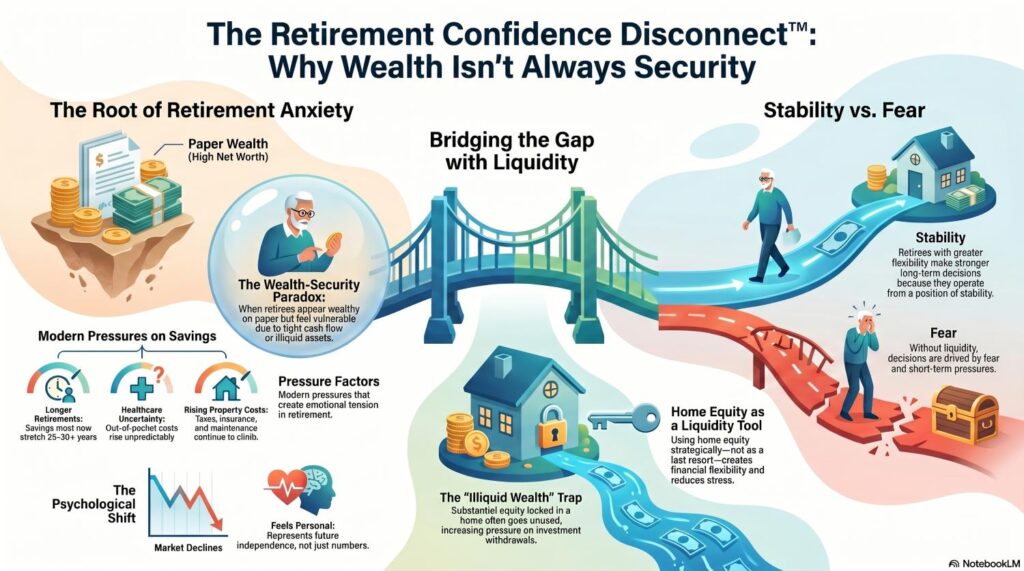
Retirement Confidence Disconnect™
What Is the Retirement Confidence Disconnect™?
The Retirement Confidence Disconnect™ happens when retirees appear financially secure on paper but still feel financially vulnerable in everyday life.
This usually occurs when:
- most wealth is tied up in investments or home equity,
- monthly cash flow feels tight,
- market volatility creates anxiety,
- or retirees fear making the wrong financial decision later in life.
In simple terms:
People may have wealth, but not confidence.
Why This Matters More Today
Today’s retirees are dealing with pressures previous generations didn’t face at the same level:
| Modern Retirement Pressure | Why It Creates Anxiety |
|---|---|
| Longer retirements | Savings must stretch across 25–30+ years instead of 10–15 |
| Inflation | Erodes purchasing power year after year |
| Healthcare uncertainty | Out-of-pocket costs continue to rise unpredictably |
| Rising property costs | Property taxes, insurance, and maintenance all keep climbing |
| Volatile markets | Retirement income tied to investments feels increasingly fragile |
At the same time, many retirees are trying to mentally preserve assets for “later,” while struggling to enjoy financial flexibility today.
That creates emotional tension.
And emotional tension changes financial behavior.
The Three Most Common Triggers of Retirement Anxiety
Fear of Running Out of Money
Even financially stable retirees often fear that one major event:
- healthcare,
- long-term care,
- or a prolonged market downturn
could permanently disrupt retirement plans.
This causes many people to over-restrict spending.
Investment Volatility Stress
When retirement income depends heavily on investment withdrawals, market declines feel personal.
Retirees stop looking at the market as numbers on a screen.
They start viewing it as:
- future security,
- lifestyle stability,
- and independence.
That psychological shift matters.
Illiquid Wealth
Many retirees have substantial equity in their homes but do not view it as part of a coordinated retirement strategy.
As a result:
- investment pressure increases,
- liquidity flexibility decreases,
- and financial anxiety often grows.
Explore Your Retirement Liquidity Options
Speak with a licensed reverse mortgage specialist — no cost, no obligation. We’re here to educate, not pressure.
Contact Us TodayWhat Most Retirement Planning Conversations Miss
Traditional planning often focuses on:
- accumulation,
- investment growth,
- and withdrawal percentages.
But many retirees are not struggling because they failed to build wealth.
They are struggling because they do not feel financially flexible.
That is a very different problem. And it requires a different type of conversation.
Where Home Equity Changes the Discussion
For some retirees, strategically evaluating home equity may help create additional financial flexibility during retirement.
Not as a “last resort.”
Not as panic-driven borrowing.
But as part of a broader retirement liquidity strategy.
This is one reason reverse mortgage conversations are slowly evolving beyond outdated stereotypes.
The real discussion is no longer simply:
“Should someone get a reverse mortgage?”
The better question is:
How can retirees create more financial flexibility without unnecessarily increasing retirement stress?
That is a far more intelligent planning discussion.
Perry Pappas Perspective
One of the biggest mistakes I see is people assuming retirement planning is purely mathematical.
It’s not.
Retirement is deeply behavioral.
Fear influences decisions.
Stress influences spending.
Uncertainty influences timing.
And often, retirees with the greatest financial flexibility make the strongest long-term decisions because they are operating from stability instead of fear.
That distinction is enormous.
Key Takeaway
Retirement confidence is not created by net worth alone.
It is created by flexibility, liquidity, and the ability to make decisions without constant financial pressure — along with the strategic integration of home equity into long-term financial stability.
That is why home equity may become an increasingly important part of retirement planning conversations in the years ahead.
Ready to Discuss Your Retirement Liquidity Strategy?
Get personalized guidance on how home equity may fit into your long-term financial picture. Straightforward education. Zero pressure.
Contact Us TodayOr call/text Perry directly at 516-851-0696
The content of this article reflects the personal perspective of the author and is for educational purposes only. It does not constitute financial, tax, or legal advice. Please consult a qualified financial advisor regarding your individual situation. Jet Direct Mortgage is not a government agency and the information presented is not approved by HUD or FHA.
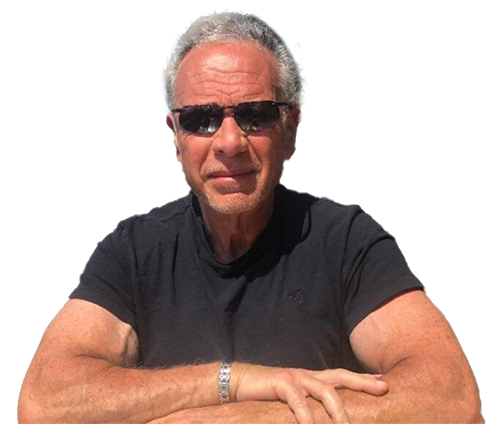
Perry Pappas is a Senior Vice President of Reverse Mortgage Sales at Jet Direct Mortgage with over 26 years of mortgage industry experience. He specializes in retirement housing strategy, senior liquidity planning, and helping older homeowners evaluate how home equity may fit into long-term financial stability. Perry is known for simplifying complex retirement financing concepts and providing straightforward education around modern reverse mortgage strategies.
Call/Text: 516-851-0696
Jet Direct Mortgage | 4875 Sunrise Hwy, Bohemia, NY 11716
Perry Pappas NMLS #3771 | Jet Direct Mortgage NMLS #3542 | Equal Housing Lender