A Smart Financial Option for Homeowners 62+
🏡 Did you know? Queens homeowners are sitting on some of the highest residential equity values in New York City. If you’re 62 or older, a reverse mortgage can turn that equity into tax-free cash — without selling your home or taking on a monthly mortgage payment.
Property values across Queens have climbed steadily over the past two decades, and for many longtime homeowners, that equity now represents the largest portion of their net worth. The challenge? It’s locked inside the walls of your home. A Queens reverse mortgage — specifically a federally-insured Home Equity Conversion Mortgage (HECM) — gives senior homeowners a way to tap into that wealth while continuing to live in the home they love.
In this guide, we’ll break down exactly how a reverse mortgage works, walk through the step-by-step process, explain repayment, and answer the questions Queens homeowners ask us most often.
💬 Have Questions About Your Eligibility?
Speak with a licensed Queens reverse mortgage specialist today — no cost, no obligation.
What Is a Reverse Mortgage?
A reverse mortgage is a loan available to homeowners age 62 and older that allows you to convert a portion of your home’s equity into cash. Unlike a traditional mortgage where you make payments to the lender, with a reverse mortgage, the lender pays you. You can receive the funds as a lump sum, monthly payments, a line of credit, or any combination of the three.
The loan isn’t due until you sell the home, move out permanently, or pass away. As long as you keep up with property taxes, homeowners insurance, and basic maintenance, you remain the homeowner and can live in the property for as long as you like.
Why Queens Homeowners Are Choosing Reverse Mortgages
- Strong home equity in Queens neighborhoods — from Bayside to Forest Hills, property values create real conversion potential.
- Rising cost of living in NYC — supplement Social Security, pensions, and savings without selling.
- No monthly mortgage payments — free up cash flow for medical expenses, home improvements, or quality of life.
- Stay in the home you love — no need to relocate out of your neighborhood, away from family or community.
- Tax-free proceeds — funds from a reverse mortgage are generally not considered taxable income (consult your tax advisor).
How Does a Reverse Mortgage Work? A Quick Snapshot
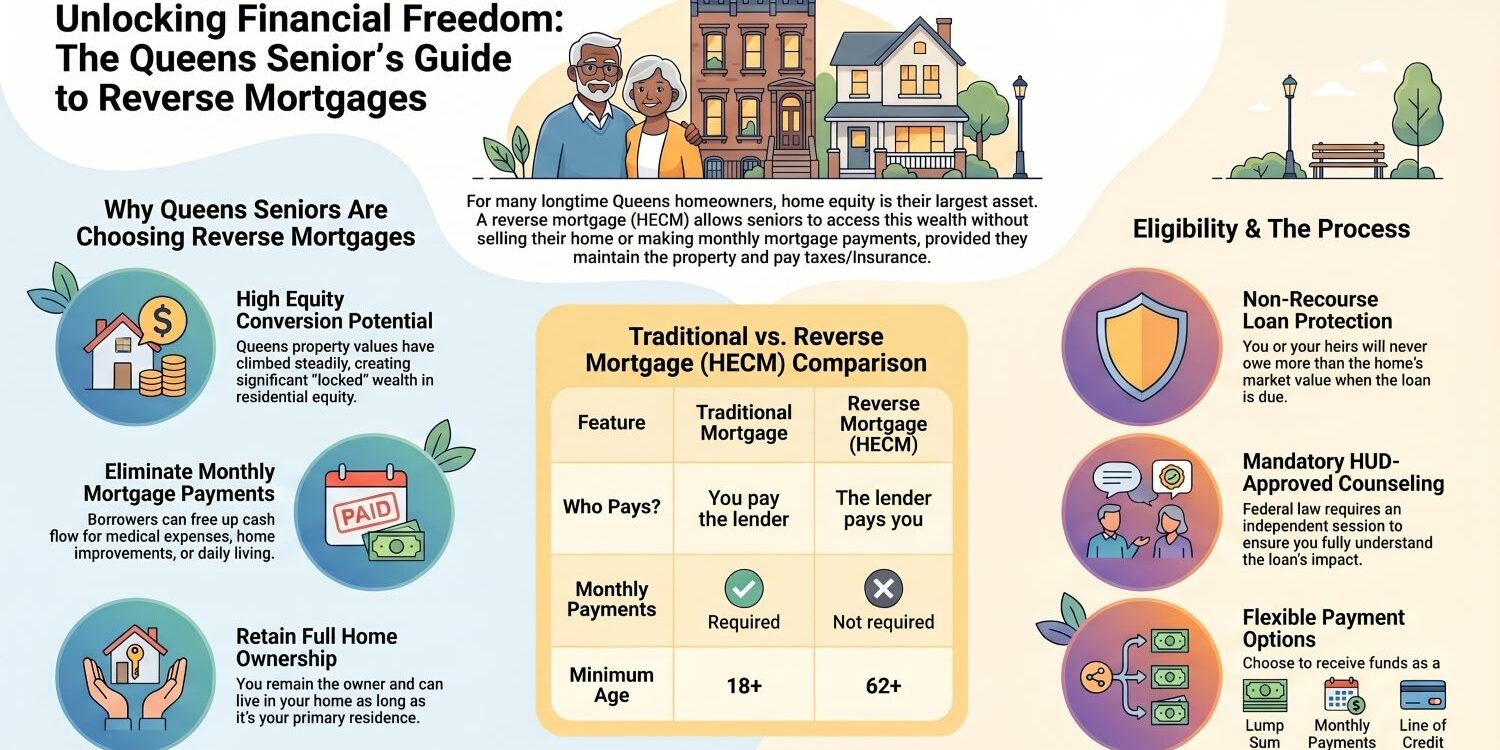
| Feature | Traditional Mortgage | Reverse Mortgage (HECM) |
|---|---|---|
| Who pays whom? | You pay the lender | The lender pays you |
| Monthly payments required? | Yes | No |
| Minimum age | 18+ | 62+ |
| Loan due date | End of loan term | When home is sold, owner moves, or passes away |
| Income qualification | Strict income/DTI rules | Flexible — focused on equity & residency |
| Home ownership | You own it | You still own it |
The Queens Reverse Mortgage Process: Step-by-Step
Getting a reverse mortgage in Queens isn’t complicated, but it does follow a specific, regulated path designed to protect you. Here’s exactly what to expect:
- Research & Initial Consultation. Start by speaking with a licensed reverse mortgage professional who can walk you through the different program options and help you decide whether a reverse mortgage fits your goals.
- Meet With a HUD-Approved Counselor. Federal law requires every reverse mortgage borrower to complete counseling with a HUD-approved counselor. This session is independent, low-cost (and often free), and ensures you fully understand what a reverse mortgage means for you and your family.
- Submit Your Application. Once you’ve chosen the program that fits your situation, you’ll complete a formal application. Your information is securely stored and transmitted throughout the process.
- Home Appraisal & Application Processing. A licensed appraiser will evaluate your Queens home to determine its market value. They’ll also check whether any repairs are required — and any necessary fixes must be completed before approval.
- Underwriting. Your loan moves into underwriting, where all details are reviewed and final approval is determined.
- Closing. After approval, you’ll attend a closing meeting to review the final terms and sign the paperwork.
- Receive Your Funds. After closing, you have a 3-business-day right of rescission to cancel. Once that window passes, you’ll begin receiving funds in whichever format you chose — lump sum, monthly payment, line of credit, or a combination.
- Repayment (Eventually). The loan becomes due only when one of three things happens: the home is sold, it stops being your primary residence, or the last borrower passes away.
🎯 Ready to find out how much you could qualify for?
Repaying a Reverse Mortgage: What You Need to Know
This is one of the most misunderstood parts of a reverse mortgage. Let’s clear it up. With a reverse mortgage, the lender pays you — either with monthly distributions or a single lump sum — and the loan balance grows over time as interest accrues. Repayment is deferred until specific events occur.
📅 When Does a Reverse Mortgage Become Due?
- Upon the death of the homeowner (the last surviving borrower)
- When the home is sold by the homeowner
- If the homeowner lives elsewhere for 12 consecutive months (for example, moving into an assisted living facility)
💰 Two Ways to Pay Off the Loan
- Proceeds from the sale of the home — the most common option. The home is sold, the loan is paid off, and any remaining equity belongs to you or your heirs.
- Heirs can refinance the loan — if your family wants to keep the home, they can refinance the balance into a traditional mortgage in their own name.
⚠️ Conditions That Could Place You in Default
Like any loan, a reverse mortgage has conditions that must be maintained. Below is a list of reasons a borrower could be considered in default:
- Failure to pay property taxes
- Failure to keep the home in good repair
- Failure to maintain homeowners insurance
- Taking on new debt secured by the home
- Bankruptcy
- Abandonment or donation of the home
- Eminent domain
💡 Important: A reverse mortgage is non-recourse, which means neither you nor your heirs will ever owe more than the home is worth when the loan becomes due — even if the loan balance has grown larger than the home’s market value.
Who Qualifies for a Queens Reverse Mortgage?
| Requirement | Details |
|---|---|
| Age | All titleholders must be 62 or older |
| Residency | Property must be your primary residence |
| Property Type | Single-family home, FHA-approved condo, or 2–4 unit property where you occupy one unit |
| Property Condition | Must meet FHA minimum property standards |
| Equity | Sufficient home equity to qualify (we can confirm this quickly) |
| Counseling | Completion of HUD-approved counseling is mandatory |
How Can You Use the Money?
One of the most attractive features of a reverse mortgage is the flexibility. There are no restrictions on how you spend the proceeds. Queens homeowners commonly use the funds for:
- 🏥 Healthcare and long-term care costs
- 🔨 Home improvements or aging-in-place modifications (grab bars, ramps, walk-in showers)
- 💳 Paying off existing mortgages or high-interest debt
- 👨👩👧 Helping children or grandchildren with education or down payments
- ✈️ Travel and quality-of-life expenses
- 💼 Supplementing retirement income when Social Security and pensions aren’t enough
- 🛡️ Creating an emergency fund through a line-of-credit option
❓ Frequently Asked Questions About Queens Reverse Mortgages
Am I eligible for a reverse mortgage in Queens?
To be eligible for a reverse mortgage, all titleholders must be age 62 or older, the home must be the borrowers’ primary residence, and it must meet Federal Housing Authority (FHA) minimum property standards. You also need sufficient home equity to qualify. A Senior Reverse Network specialist can quickly confirm whether you meet these requirements.
Will the bank own my house?
No. Just like a traditional mortgage, as long as the terms of the loan are met, you retain full homeownership and can sell the home at any time. The bank places a lien on the property (just as they do with any mortgage), but the title stays in your name.
How much money can I get from a reverse mortgage?
The amount you can receive is determined by several factors: the age of the youngest borrower (or eligible non-borrowing spouse), your home’s appraised value, the amount of equity you have, current FHA lending limits, the interest rate, and which reverse mortgage product and payment option you choose. Senior Reverse Network can provide a personalized quote based on your specific Queens property — at no cost and with no obligation.
How do I receive my proceeds?
You have flexible options. You can take your funds as a lump sum, as monthly payments (for a specified period or for as long as you live in the home), as a line of credit, or as any combination of these.
Am I spending my children’s inheritance?
Not necessarily. A reverse mortgage may help you plan for a more comfortable, financially independent retirement. We always encourage you to involve family members in the decision. When the home is eventually sold or is no longer your primary residence, the loan is repaid — and any remaining equity belongs to you or your estate and can be transferred to your heirs.
What are the costs associated with a reverse mortgage?
In addition to interest, costs can include a property appraisal fee, origination fee, closing costs, mortgage insurance premium, servicing fee, and a modest charge for HECM counseling. While closing costs vary by loan type and size, they’re comparable to those for a traditional mortgage. Most up-front costs can be rolled into the loan to minimize out-of-pocket expense. We’re happy to provide a detailed cost breakdown.
Can I lose my Queens home with a reverse mortgage?
As long as you continue to pay property taxes, maintain homeowners insurance, and keep the home in reasonable repair, you can stay in your home for as long as you live there as your primary residence. The risks come only from failing to meet these basic obligations.
How long does the reverse mortgage process take?
On average, the full process — from initial consultation to closing — takes 30 to 45 days, depending on appraisal scheduling, counseling availability, and any required repairs. We’ll keep you informed at every step.
Are reverse mortgage proceeds taxable?
Generally, reverse mortgage proceeds are not considered taxable income because they’re a loan, not earnings. The funds also typically don’t affect Social Security or Medicare benefits. However, they may affect needs-based programs like Medicaid or SSI, so we always recommend consulting a tax advisor about your specific situation.
What happens to my reverse mortgage if I pass away?
The loan becomes due. Your heirs typically have a few options: they can sell the home and use the proceeds to pay off the loan (any remaining equity is theirs), or they can refinance the loan into a traditional mortgage if they want to keep the property. Because reverse mortgages are non-recourse loans, heirs will never owe more than the home is worth.
Why Choose Senior Reverse Network for Your Queens Reverse Mortgage?
- Local NY expertise — based in Bohemia, NY, and serving Queens homeowners for years
- Licensed Mortgage Banker with the NYS Department of Financial Services (NMLS #3542)
- No-pressure consultations — we educate first; you decide on your timeline
- Personalized quotes tailored to your specific Queens property and goals
- Family-inclusive approach — we welcome your loved ones into the conversation
🏠 Turn Your Queens Home Equity Into Financial Freedom
Connect with a licensed reverse mortgage specialist today. Get straightforward answers, a free personalized quote, and zero obligation.
📞 Or call us directly at 866.203.1231
Senior Reverse Network is not a government agency. The content on this page is not from HUD or FHA and is not approved by the Department or any government agency. Reverse mortgages are subject to credit approval and program requirements. Please consult a tax advisor regarding your specific situation.